Monday, April 21, 2008

Following the Alewife

I've been going to Cape Cod since before I can remember. I spent every summer there growing up, which undoubtedly has had a major hand in shaping who and where I am today. Yet after all this time, it took me until today to witness one of the most dramatic and awe-inspiring feats of biology the Cape has to offer - the running of the alewife. In fact, it wasn't until I read John Hay's The Run a few years back that I even knew such a phenomenon was right in front of me all this time. Written in the 1950s, this book is, as most John Hay books are, a wonderful combination of natural history and philosophy. Since reading it, timing and distance have kept me from witnessing the run for myself, but about a month or so ago, I decided that I would make a concerted effort to see it this year. So with camera in hand, I headed out to the Cape over the weekend in hopes of catching the little critters in action.

Alewife, Alosa pseudoharengus, are anadromous fish of the shad family (Clupeidae) found along the eastern seaboard of North America from Newfoundland south to the Carolinas. Also known as herring (though not a "true" herring), alewife spend the majority of their life at sea, returning to freshwater ponds to spawn (as opposed to catadromous fish, such as Anguilla eels, which live primarily in fresh water, but spawn in the ocean). After spending a few years in the ocean, feeding and growing and surviving, the alewife gather just offshore in late-March to early-April. Shortly after this, on some cue (temperature? light? tides? moon phase? boredom?), the alewife start to migrate up the various tidal creeks to their spawning grounds, first in spits and spurts of individuals and then finally, by mid to late April, en masse. On the Cape there are a number of historic "herring runs", but one of the best known (and healthiest) is the Stony Brook run in Brewster. This is the run that John Hay wrote about and this is the run that I visited to follow the path the alewife take.

The Stony Brook run begins here at the mouth of Paine's Creek, a tidal stream that empties into Cape Cod Bay at Paine's Creek Beach:


Alewife that have successfully reached maturity and have made it to this point must now run a gauntlet to the spawning grounds. As they leave the ocean and travel upstream, they meander approximately a half mile through Paine's Creek into fresher and fresher water:


At this point, the creek goes through a culvert:


and crossed under route 6A:


Emerging on the other side, Paine's Creek becomes known as Stony Brook. The alewife must now swim another half a mile or so through Stony Brook and its surrounding marshes:


I am sure not every alewife that enters Paine's Creek makes it this far, but the journey to this point has been a cake walk compared to what comes next. As the alewife approach the fish ladder they have to contend with a nightmarish scene right out of Finding Nemo:


The only way any alewife can make it past that is if they come through in such numbers that the gulls can't possibly catch them all. Those that make it this far school together in shallow pools before continuing on:


After they've had a chance to rest a bit, individual alewife start to make the final push and head up the fish ladder. Here they make sprints up each cascade and are bashed and batted by the water and rocks. Many have to make several attempts as they are pushed back down or smack against the sides of the ladder. The energy it takes to do this must be enormous.


Next it's through another culvert, under Stony Brook Road, past the old mill, and up the last stretch of the brook:


Those that make it this far are rewarded with their ultimate destination, the quiet of Lower Mill Pond:


and the right to spawn before turning around and heading back through the gauntlet to the sea, where the open jaws of the season's first stripers will be waiting for them. It's not easy being an alewife.

This was quite a sight to see and I recommend that anyone on or near the Cape to go check it out. I don't know how long the alewife will be running or if I happened to catch them on a plentiful day, but the numbers were staggering. So many that even the air smelled fishy. However, there were people around who were talking about how much more plentiful the herring were when they were kids and telling stories of people pulling baskets full of fish out of the stream (no taking is allowed now). I don't think these were simply curmudgeony back-in-my-day sorts of stories - alewife numbers are down all along the coast and some historic runs no longer run. A variety of factors are seemingly at fault, such as poorly regulated fisheries, destruction or obstruction of spawning grounds, and polluted waterways.
(UPDATE: just found a video taken at a Harwich, MA herring run a couple of days ago showing the better-than-expected alewife numbers this year.)

In addition to the moratorium on the alewife fishery there are programs in place to help monitor and restore the fish populations. Hopefully enough can be done to ensure the continuation of this primeval rite of spring. As John Hay wrote close to a half-century ago, the running of the alewife has meaning beyond a bunch of fish racing up a stream:

...it seemed to announce that bud scales on shrubs and trees would start to crack and fall away to let the inner shoots unfold as leaves and feed on the sun. It said that flies and wasps and spiders would come out of winter biding and sleeping, that the song sparrows would begin to sing in the willows and viburnum bushes...There is something exciting and strange about the sudden appearance of new life in the spring, coming from another region, another climate...They recur; they are recognizable; and yet they bring in endless tides and vivid journeys


(For more info on alewives, check out this Audubon article and read John Hay's book)

Sunday, April 20, 2008

Slowly, but surely

Littorina littorea - Paine's Creek Beach, Brewster, MA

Saturday, April 19, 2008

Weekly Urchin: Pedicellariae

A few weeks back I offered up the sea urchin feeding mechanism, Aristotle's Lantern, as a reason why echinoderms are way cooler than molluscs. In the comments of that post, JasonR of CephaloPodcast suggested that if I wanted to impress them I should write something about pedicellariae. Now, I'm not one to kowtow to the demands of the mollusc camp, but pedicellariae are rather cool and certainly worth a weekly urchin post.

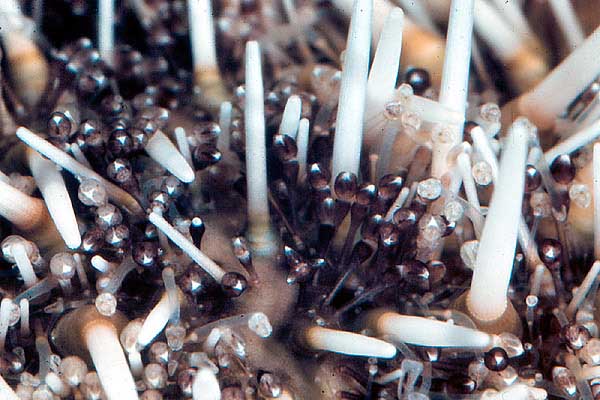
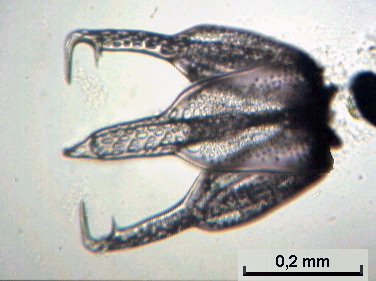
Pedicellariae are small, stalked appendages that are scattered among the spines and tube feet of some sea stars and urchins. The head of each pedicellaria is akin to a three-piece claw. This "claw" is used for a variety of functions, including defense, food capture, and the removal of encrusting critters (e.g. parasites, algae, settling larvae). Some echinoderm species may even use their pedicellariae to hold onto pieces of algae or debris as a form of camouflage - though urchins will also use their tube feet for this.


When first described in the 18th century, pedicellariae were thought to be parasites on the tests of sea urchins and were assigned to three species in the genus Pedicellaria. A century later it was realized that these parasite "species" were actually specialized urchin/sea star structures that differed in form - tridentate, triphyllous , globiferous - each with a different function and found in different numbers, combinations, and locations depending on the species. Globiferous pedicellariae are particularly nasty - sharp, hooked, and poisonous. In some urchins, like the "flower" urchins of the genus Toxopneustes, the pedicellariae are more prevalent, and more injurious, than the spines.


As it is getting late, I'll leave you with this brief video of pedicellariae in action.

Friday, April 18, 2008

Friday Dial Stopper

Something new, even though it sounds a bit like old-school Pumpkins. And is it just me or does the lead singer here look a lot like the Bard of the Spineless, Kevin Z, with his hair grown out a bit more?


Tuesday, April 15, 2008

more salty poetry

I particularly like the last stanza

Sun and Shadow
by Oliver Wendell Holmes, Sr.

As I look from the isle, o'er its billows of green,
To the billows of foam-crested blue,
Yon bark, that afar in the distance is seen,
Half dreaming, my eyes will pursue:
Now dark in the shadow, she scatters the spray
As the chaff in the stroke of the flail;
Now white as the sea-gull, she flies on her way,
The sun gleaming bright on her sail.

Yet her pilot is thinking of dangers to shun,--
Of breakers that whiten and roar;
How little he cares, if in shadow or sun
They see him who gaze from the shore!
He looks to the beacon that looms from the reef,
To the rock that is under his lee,
As he drifts on the blast, like a wind-wafted leaf,
O'er the gulfs of the desolate sea.

Thus drifting afar to the dim-vaulted caves
Where life and its ventures are laid,
The dreamers who gaze while we battle the waves
May see us in sunshine or shade;
Yet true to our course, though the shadows grow dark,
We'll trim our broad sail as before,
And stand by the rudder that governs the bark,
Nor ask how we look from the shore!

Monday, April 14, 2008

salty poetry

The scurvy dogs good folks over at Deep Sea News have been sharing some ocean-themed poetry as part of National Poetry Month so I thought I would chime in with some of my favorites. First up, maggie and milly and molly and may by e.e. cummings - it seems particularly fitting given how I spent part of this past weekend.

maggie and milly and molly and may
by e.e. cummings

maggie and milly and molly and may
went down to the beach(to play one day)

and maggie discovered a shell that sang
so sweetly she couldn't remember her troubles,and

milly befriended a stranded star
whose rays five languid fingers were;

and molly was chased by a horrible thing
which raced sideways while blowing bubbles:and

may came home with a smooth round stone
as small as a world and as large as alone.

For whatever we lose(like a you or a me)
it's always ourselves we find in the sea

Linnaeus' Legacy #6

Better late than never, right?

The Invertebrate Battle Royal and the Circus of the Spineless has taken its toll, and I have not been able to give this month's Linnaeus' Legacy the attention it deserves. So, since the month is almost half over, I figured I needed to get something down ASAP. So, without further delay or, unfortunately, pomp and circumstance, I give you the 6th edition of Linnaeus' Legacy.

Matt at Birder's World introduces us (or at least me) to the mostly-forgotten flightless seaduck of California and the fact that it may be one of the earliest examples of the catastrophe rained down by humans on flightless birds

Nimravid has a report on recent research into the evolution of ant agriculture. A very interesting read as it turns out the various types of fungal farming done by ants align very nicely with the ant phylogeny. Nimravid also has an excellent summary for understanding evolutionary trees - a must read for the cladogramatically-challenged.

Mike at 10,000 birds muses about horned larks, populations, subspecies, and clines. And Great Tits. Mustn't forget the Great Tits.

PodBlack Cat discusses the taxonomic crisis (taxonomist crisis?) in general and the "Michael McRae" crisis in particular (go read it and find out). (PodBlack Cat also submitted a post on the gender gap in education, which, while I do not think fits with this carnival, is an excellent read. Does the fact that I just linked to it mean that it fits with this carnival?)

Speaking of crises in taxonomy, Christopher Taylor, founding father of Linnaeus' Legacy, reports on biopiracy policies in India adversely affecting entomological research there as well as some naming issues revolving around the protist genus Monas

GrrlScientist reports on a newly discovered bird species in Indonesia.

Greg Laden brings us up to date on the Flores "Hobbit" saga with a summary of some statistical work which suggests that the Flores hominids were not diseased humans, as some suggest, but a separate species. (if you need a refresher, check out Carl Zimmer's timeline of hobbit-related events)

John at A DC Birding Blog implicates political meddling in the difficulty of getting new endangered species listed under the Bush (v.2) administration.

The World We Don't Live In (a blog new to me, but one that I will be checking out regularly from now on) had several posts nominated by Christopher Taylor, including a nice descriptions of the ostracodesque Tuzoia and the elaborately-adorned protoceratids.

OK, folks, that's it for this edition of Linnaeus' Legacy - my apologies for its tardiness. The next edition will be hosted by The Ethical Palaeontologist (does this imply that other palaeontologists are unethical?) - hopefully, Julia will be more punctual than I.

Thursday, April 10, 2008

Hey Montreal, whatcha gonna do when Lucic runs wild on you? Oooh yeah!

Advance apologies for the violence of this post, but it's Stanley Cup playoff time in the Hub once again and left winger Milan Lucic is bringing some toughness back to the B's. For those of you who don't like fighting, hockey or other atavistic displays of testosterone, just ignore this post. Intelligent posting will resume shortly.

(BTW Boston is the #8 seed; the Habs are the #1; the B's lost all 8 regular season games against Montreal this year; Lucic beating someone up may be all that I can hope for in this series)

painful, yet funny

Can't believe I'm drawing attention to this, but I figured I better do it before Gibbon Jockey does - it'll take some of the sting out of it.

Tuesday, April 08, 2008

Help a young invertaphile out

I got this wonderful email the other day. It's wonderful on several levels - first, it's proof that someone actually reads this thing; second, the author, clearly an intelligent and sane individual, rightfully sees the "inherent" greatness of Aristotle's Lantern; and third, the author is a college-bound student that already has the drive and interest to work with inverts - and not your standard inverts either, but the Tardigrada (bonus video here). I would like to do what I can to help this student out, but all I could offer was that she contact the biology faculty at Mt. Holyoke. She agreed to let me post her request here in hopes that someone else might be able to offer more. Please take a read and leave any suggestions in the comments.

This is totally out of the blue, but I stumbled upon your argument for the wondrousness of the aristotle's lantern in Echinoderms. While I always thought this structure to be inherently greater than the radula, I found your vehemence intriguing. I took it upon myself to find out who you were, and upon seeing that you taught in Massachusetts, a thought occurred. I will be attending Mount Holyoke college in South Hadley, MASS beginning next year and am intensely interested in invertebrates (namely the Tardigrade). If you know of any research or intern positions for those with no college experience under their belt, I would be eternally grateful to obtain such information. I may be starting in the spring term (in 2009), so anything starting then, or even as soon as the summer, would be ideal.

An olive branch...

This was shown today during a faculty-candidate seminar for our very cool joint position with the New England Aquarium. I have to admit, no sea urchin could do this...perhaps not all molluscs are totally uncool.

Octopus escaping through a 1 inch 2.5 cm hole

Darwin on acid?

Gibbon Jockey made a rare find - one of Darwin's music videos. Who knew?

Sunday, April 06, 2008

Coming soon - yet another Carnival

As I have pointed out, I managed to get myself involved in two carnivals back to back. The Circus of the Spineless is hardly cold, yet I need to move on to the April edition of Linnaeus' Legacy. So, once again, I am sending out a request for posts - if you have something suitable for Linnaeus' Legacy please email them to me at jim{dot}lemire{at}gmail{dot}com. This time around, I'll try to keep my mollusc-bashing to a minimum. I promise.

Thursday, April 03, 2008

Return of the Sloths

When I first started this blog I was teaching AP Biology at the local high school and used this space as an extension of class discussions and for "bonus" material we didn't have time to talk about. One of those topics was on sloths - in particular their body temperature, enzyme kinetics and evolution. I'm pretty sure none of my former students still read this space - or if they do they remain hidden from view - but I was reminded of them when I read about the extinct, marine sloth, Thalassocnus, over at Catalogue of Organisms.

Pretty cool, for a vertebrate.

Wednesday, April 02, 2008

Circus of the Spineless

Welcome to the March edition of the Circus of the Spineless. Yeah, yeah, I know it's April already....give me a break. If Major League Baseball wants to say that the Red Sox season began a week ago, I can say this is the March edition.

Actually, this moth's celebration of all things spineless couldn't have come at a better time. With the blogosphere currently embroiled in the Invertebrate Battle Royal, what better time to bring us all together in the spirit of peace and harmony, united behind our wonder and love for the entirety of invertebrate diversity, to stand arm in arm, putting our petty differences aside to celebrate the natural world to stick it the mollusc camp and prove once and for all the superiority of the echinoderms and all things unmolluscan (well, maybe not all things unmolluscan)? What can I say, I'm a divider, not a unifier. Forces are being divvied up and what was once a simple Holothoroidea vs. Mollusca battle is becoming a war between the all-mighty, wicked cool deuterostomes and the pathetic protostomes. Yes, I said wicked cool. Choose your allegiances wisely - no one likes a turncoat.

With a dearth of submissions a day ago, this was looking like it was going to be an all-urchin carnival, but a flurry of emails over the past 24 hours has beefed it up considerably, though predictably heavy on the arthropod front. It is possible that some submissions were inadvertently dumped by my spam filter - if so, I apologize. Unless they were about molluscs. On an only tangentially related note, in honor of Gibbon Jockey, I'd like to nominate the Indiana men's basketball team as the spineless champion of the month.

Now on to the Circus.

Phylum Echinodermata:

  • Kevin Zelnio, in a moment of sanity that he later renounces, gives us a great post about how the remarkable ability of sea cucumbers to quickly change the stiffness of their skin by rearranging collagen nanofibers has inspired some far-thinking scientists to use this biological marvel to help treat Parkinson's. How cool is that? Man, those echinoderms never cease to amaze.


  • In anticipation of a short vacation to the Domincan Republic, yours truly offered up a post on the remarkable sea urchin Diadema antillarum and the fate that has befallen it. And speaking of ultra-cool echinoderms, you can also find my foray into the Battle Royal with a brief description of the coolest feeding structure in all of Animaldom. And while I'm self-promoting, check out this urchin-themed music video I found. Does calamari have such a thing? I think not!


  • Phylum Urochordata:
  • Jumping in on the deuterostome side of the war is Miriam at The Oyster's Garter (what an unfortunately blog name) with her delineation of all the cool things about tunicates
  • .

    Phylum Cnidaria:
  • Reporting on a phylum only slightly less cool than Echinodermata (but light-years ahead of those bilateral molluscan schmucks), Rick of Malaria, Bedbugs, Sea Lice, and Sunsets reports on yet another threat to the increasingly-vulnerable corals - other corals.


  • Phylum Annelida:
  • Budak needs some help IDing this polychaete. Nice photo.


  • Phylum Endoprocta:
  • Christopher at Catalogue of Organisms gets his first look at the endoprocts. Personally, I haven't had the privilege, but based on Christopher's description I can tell they're way cooler than molluscs.


  • Phylum Arthropoda:
    Class Insecta
  • Duncan has a very nice journal-like account of a dragonfly expedition - part 1, part 2. The description and details provided by Duncan make you feel like you're there. And best of all, not a snail in sight!


  • Both Ed at Not Exactly Rocket Science and John at a DC Birding Blog discuss how moths can remember lessons learned as a caterpillar. Yes, that's right, moths retain memories from their larval stages.


  • Doug at Gossamer Tapestry makes a case for considering addding the Swamp Metalmark to the endangered species list.


  • RPM at evolgen explains that sleep-deprived male Drosophila are less interested in sex than their well-rested counterparts. The question I have though is how does one deprive fruit vinegar flies of sleep?


  • Susannah (AKA Wanderin' Weeta) offers up some tips on photographing carpet beetles and wonders if they get hangovers. To quote Susannah from her email, "Not a mollusc, fortunately." See, Wanderin' Weeta gets it.


  • Budak offers us two poetic insect posts. First on the Diptera-like Bembix wasp and another on the softer side of assassin bugs. You should definitely follow the image links to his Flickr account for some wonderful images.


  • Rurality gives us some pics of and musings on the Hummingbird Clearwing Moth. Must be nice to have insects flitting about flowers this time of year. Tomorrow's forecast here is for a balmy 37oF!


  • Jenn at Invasive Species Weblog wisely stays clear of sending me any of her mussel posts. Instead, she paraphrases one of my favorite Good Will Hunting lines in a report on the Apple Moth and its likely lack of invasive potential here in the U.S. She also sent along a photo of a member of one of the coolest groups of insects - the Prodoxidae or yucca moths (my grad work was on the population genetics of yuccas and yucca moths, so I may be a bit biased)


  • Class Arachnida
  • Troy over at Ramblings Around Texas has a brief introduction to spiders in general and wolf and orb-weaving spiders in particular. Be sure to click on the images for some stunning shots.


  • Class Malacostraca
  • Ed joined the Great Invertebrate War with his post on the phenomenal vision of the mantis shrimp. I guess mantis shrimp are pretty cool...in a thuggish, Whitey Bulger sort of way - check out the video at the end of Ed's post to see a mantis shrimp terrorizing fellow crustaceans. Not just spineless, but heartless, I tell you.


  • Andrea was buzzing about her garden during the vernal solstice equinox this year, but only managed to find some roly-poly pill bugs. For some reason, these guys have always grossed me out. I can't even imagine carrying them around in my pockets.


  • Phylum Mollusca:
  • Kevin Z has some drivel about snail mucus as a wonder cure for wrinkly skin. See, aren't molluscs just the coolest? Pah-lease.


  • Budak highlights how to catch octopus in Singapore. So much for the supposed brainiacs of the spineless. Stupid molluscs. (note: as always with Budak's posts, be sure to follow the links for some nice photos)


  • In what I can only fathom was an attempt to be true to his blog's title (why else would an intelligent person blog about molluscs?), Christopher at the Catalogue of Organisms, gives us a description of those quirky gastropods, the struthiolariids, aka "ostrich foot shells". Man, nothing cooler than snails named after, yet lacking any resemblance to, the appendages of large flightless birds. If this doesn't prove Craig's case, I don't know what will.


  • Well, that's all folks. Hopefully, I've managed to do my part in the Great Invertebrate War and convinced all of you how uncool molluscs are. If not, you can send your rebuttal to the April edition of the Circus to be hosted by Deep Sea News - you're sure to find a sympathetic ear there. On a another note, I'll be hosting the April edition of Linnaeus' Legacy in a few days or so, so send me your posts!

    Tuesday, April 01, 2008

    Friday Dial Stopper - late edition

    While embroiled in the Great Invertebrate War of 2008, I seem to have forgotten about the Friday Dial Stopper last week. That just won't do. Especially since this last week's dial stopper is more than just a dial stopper - it's the epitome of an entire generation, it defines a genre and changed the direction of music. It would have been a shame to let such an important piece of music slip by, so instead I give you this late edition of FDS.

    Monday, March 31, 2008

    RFP: Circus of the Spineless

    I'm making one last request for posts for this month's Circus of the Spineless. I should have it up in the next couple of days, but I have relatively few submissions. Please send all your invertebrate-themed writings to me at jim{dot}lemire{at}gmail{dot}com

    Please note that Echinoderm posts will be given top priority, followed, in order, by posts on Cnidaria, Ctenophora, Annelida, Arthropoda, Platyhelminthes, Porifera, Nemertea, Chaetognatha, Sipuncula, Bryozoa, Tardigrada, Onychophora, Brachiopoda, any non-Mollusca phylum not already mentioned, and finally, if there is room and I have time for them, the tragically uncool Mollusca.

    Also, I noticed over the weekend that at least one CoS submission was delivered to my spam folder. I normally do not check my spam and erase it all unseen, so it is possible that some submissions have been unwittingly deleted. I generally send an email confirming that I received your submission, so if you sent something to me and I did not reply, please resend. Thanks.

    Friday, March 28, 2008

    Echinoderms are so much cooler than Molluscs (or why Craig McClain is off his rocker)

    So, I go away on vacation for a few days and upon my return, as I am catching up on all my favorite blogs, I'm blindsided by the outbreak of war. And not your typical war either, but a vicious series of unprovoked and uncalled for attacks (Ok, maybe it is like a typical war). It seems that Dr. Craig R. McClain of Deep Sea News has thrown down the gauntlet by making a series of scathing posts concerning his erroneous belief that molluscs are somehow cooler than echinoderms. Now I just cannot stand for this. Especially after reading about how the molluscan radula is deemed one of the reasons this phylum is so cool compared to the echinodermata. I'm sorry, but Craig must not be thinking clearly. The radula? A spiky ribbon makes molluscs cool? Please. Don't waste your time, Craig. If we're going to be comparing feeding apparatuses (apparati?) of molluscs and echinoderms, your precious mantle-wearing protostomes don't stand a chance. Echinoderms utilize one of, if not the, coolest feeding mechanism in the animal kingdom - Aristotle's Lantern.

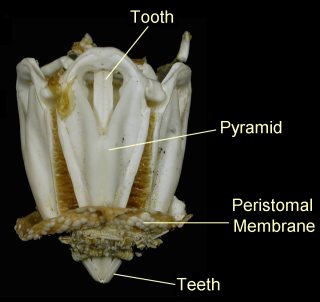
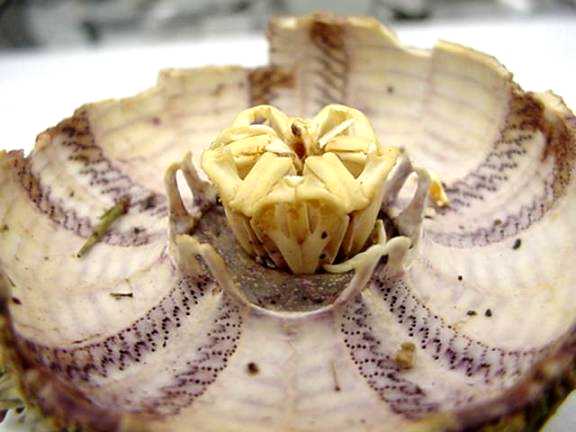
    First off, few structures in living organisms have as cool a name as "Aristotle's Lantern" - this structure was described by Aristotle in his Historia Animalium written around 343 BC. Second off, it is an "architectural marvel"1, consisting of a complex of "50 skeletal elements and worked by 60 muscles"2. The structure contains a set of five calcareous pyramids, each with a canal where a long, sharp tooth lies and protrudes outside the oral cavity. The teeth can be protracted and spread apart through the constriction muscles that push the entire lantern orally. Retraction of the "jaw" involves another set of muscles. Yet other muscles can produce swivel and rocking movement of the teeth and lantern apparatus. I'm sorry, but a radula cannot compete with this.

    It is hard to comprehend the complexity and coolness of Aristotle's Lantern without seeing one in person, but here are a few images to help you:


    Sorry Craig, but you've got no case here. Get that weak-ass radula crap outa my house.

    Friday, March 21, 2008

    Weekly Urchin: Friday Dial Stopper edition

    Back from the D.R. - great time - photos to come (hopefully) - battling the flu now unfortunately. More next week. Until then, enjoy this combo urchin-dial stopper offering. And no, that is not me with a bad haircut.

    Friday, March 14, 2008

    Packing for the D.R.

    Do I need anything else?

    Friday Dial Stopper - early St. Patrick's Day edition

    Since I won't be near a computer on Monday, here's a duo of dial stoppers in the spirit of the season. Have a happy and safe St. Patty's Day - even if you're not Irish. Yo ho ho and a bottle of rum whiskey.


    "Salty Dog" by Flogging Molly

    Powered by Podbean.com

    Tuesday, March 11, 2008

    Weekly Urchin - Dominican Republic edition


    In anticipation of Linda's and my vacation to the Dominican Republic in a few days, I give you Diadema antillarum, the long-spined sea urchin. This urchin is a keystone herbivore on coral reefs throughout the Caribbean and one I hope to see during our vacation.

    This particular species was once a dominant part of coral reef communities. However, a catastrophic die-off in 1983, the result of an unknown pathogen, resulted in an over 97% mortality rate Caribbean-wide - the most severe mass mortality ever recorded for a marine organism. The disappearance of D. antillarum from the reefs lead to the proliferation of macro-algae which quickly overtook the coral reefs. This unchecked algal cover resulted in coral die-off and prevented new coral recruitment. The result was an overall deterioration of reef communities. Although there have been reports of localized D. antillarum and subsequent coral reef recovery (Edmunds and Carpenter 2001), populations remain low even decades later (Lessios 2005 - pdf). Continued research and coral reef restoration using reared and/or transplanted D. antillarum are currently underway.

    Changing tacks a bit, below is a stunning video of D. antillarum development from Diadema.org. The video is a bit long, but it comes complete with a soundtrack by Enya (I believe) and contains amazing footage of a metamorphosing larva - if nothing else, you need to watch for this (about a third to half-way in).


    How many legs does an insect have?

    Not a question one would think one would have to ask an undergraduate. Especially, an undergraduate majoring in biology.

    However, if such a question does need to be asked, one would like to think that the answer would not be:
    "Eight? More than eight? I don't know."

    EIGHT!?!?!?!?!?! MORE THAN EIGHT?!?!?!?!?! I DON'T KNOW!?!?!?!?!?!?!

    I'm pretty sure my 4-year old knows this answer. And if he doesn't, my 7-year old certainly does.

    Hell in a hand basket, people. Hell in a hand basket.

    Saturday, March 08, 2008

    Wolves loose in Massachusetts?

    This is some very exciting news. After over 150 years of being absent from the state, a wild gray eastern wolf (Canis lupus lycaon*) has been positively ID'ed in western Mass. Unfortunately, it was also shot dead after MassWildlife officials told the farmer whose livestock was being eaten that the culprit was a dog and that the "dog" could be legally shot if it was ever seen again on his property. Well, sure enough, the farmer saw the "dog" and killed it. Only upon inspection of the dead dog wolf did they realize what they had. DNA tests done by the US Fish and Wildlife Service at their Forensics Lab confirmed the identification. (BTW, I always thought that the USFWS Forensics Lab would be a cool place to work). Of course, now there are numerous questions about where this animal came from and if this means that the gray eastern wolf is naturally recolonizing its former New England range.

    Personally, I think this is outstanding news - native species, reclaiming their native territories, on their own. The presence of this wolf in western Mass suggests that there are viable green corridors connecting the state with healthy wolf packs in Canada. I'm not sure this state is ready for the reappearance of wolves - I'm sure no one has been discussing the possibility much after over a century of absence - but hopefully, the next wolf won't be so unceremoniously shot.

    Speaking of being unceremoniously shot, I find it odd that neither MassWildlife's nor the Massachusetts Department of Fish and Game's website has any mention of this event. Clearly, they can't be too thrilled about the wolf being killed, but wouldn't you think the presence of the first wolf in Massachusetts in 160 years would be heralded by the state's wildlife conservation agencies?

    *Recent genetic evidence suggests that the eastern wolf is a distinct species and neither a subspecies of the gray wolf, Canis lupus, nor a gray wolf-coyote hybrid as once proposed

    Carnival overload


    I may have gotten myself in over my head. I signed up to host the March edition of the Circus of the Spineless and the April edition of Linnaeus' Legacy. Two carnivals in two months. No problem right? So I thought.

    However, I did not do my homework. It seems that Circus of the Spineless comes out at the end of the month and Linnaeus' Legacy comes out at the beginning of the month. So, instead of hosting two carnivals a month apart, I will be hosting two carnivals days apart. This didn't hit me until I started getting emails for both carnivals. Oops. The killer too is that I remember specifically asking not to host the March edition of LL so as not to double up.

    Well, the carnival(s) must go on, so send in those posts - all things invertebrate for Circus of the Spineless and all things taxonomic for Linnaeus' Legacy. And for all you invertebrate taxonomists out there, you may pick either or both (but not neither). I'll keep up as best I can.

    Friday, March 07, 2008

    Friday Dial Stopper

    Slow blogging week - I don't think I've sat at my computer for more than a few minutes at a time, and even then it was just to enter grades or type something up for class. But I couldn't let the week go by without the Friday Dial Stopper...

    Not sure if this one has the stuff to stay a dial stopper for the long haul, but it's still new enough to be one now. (apologies for the relatively poor feed on the video - it's the best original video I could find to embed - YouTube's version has had its embedding capability "disabled by request")

    Wednesday, March 05, 2008

    Can we just secede already?

    Reason 1,332 why I'm proud to be a New Englander

    Saturday, March 01, 2008

    I've always wanted one of these

    Michael over at The Dispersal of Darwin has graciously bestowed upon this humble (yeah right!) blog the award of excellence. Thank you, Michael. I am honored.

    The acceptance of this award seems to stipulate that I nominate other blogs for this award. Well, the number of blogs I read is relatively small. Those that I deem excellent and thus read daily (if not hourly) are those that I have added to the right over there under "Me Bloggin' Mates". So, if your blog appears there, consider yourself nominated for blogging excellence. Occasionally, I add new blogs to my blogroll, so if your name is added in the future, please also consider yourself nominated for this prestigious award.

    Are you going to argue with Jack Nicholson?

    This is simply brilliant.

    Friday, February 29, 2008

    Friday Dial Stopper

    Here's another Friday Dial Stopper that breaks the rules. I don't think I've ever heard this song on the radio. However, if it ever were to be played, my dial would come to a screeching halt faster than Roger Clemens's plans for a post-baseball life of celebrity benefit appearances.

    And speaking of baseball, today's Dial Stopper is for you, Johnny B.

    Wednesday, February 27, 2008

    Listen closely

    Watch this trailer for the movie "The Fall" and see if you do a double take like I did. The whole clip is thoroughly bizarre, yet there is one thing that jumps right out at you as being totally out of place.


    (hat tip to Acephalous, via Pharyngula)

    Tuesday, February 26, 2008

    Encyclopedia of Life now online...sort of

    I was pretty excited to get an email announcing the launch of the Encyclopedia of Life. Unfortunately, they do not appear to be quite ready to receive the multitude of visitors that are trying to get there and the site is "Temporarily Unavailble". There was also a link to a newsletter in the email I recieved, but the link brings up the dreaded "Page Not Found" error.

    I suppose it is not so bad a thing that folks are overwhelming the server to get EOL. It means there is lots of interest in the project. I assume that they have IT folks working on the problem as I write and the situation will be resolved soon.

    For the time being, you can check out this NY Times article on the project, courtesy of Carl Zimmer.

    UPDATE: the site now appears to be accessible. However it is loading very slowly.

    Sunday, February 24, 2008

    Clearly, I'm in the wrong business...(alternate title: People Are Dumber Than I Thought)

    Out at breakfast this morning, I came across a catalog for Learning Connections, which "offers a wide variety of short courses, trips, and seminars designed for adults in Rhode Island and the South Coast region of Massachusetts." At first glance through the courses they offer, it looked like the sort of stuff you find at a local community center - classes in cake decorating, introductory Spanish, ballroom dancing, etc. There were even some classes that looked intriguing to me - like the "Seasonal Italian Cooking Series" and "Scotch Whiskey: An Exploration into Malt". And then I flipped to the pages in the back and find "classes" such as:

    Spirit Flame Pictures

    Those in the spirit world communicate with us in various ways. In this fun, eye-opening class, use index cards and a candle and see what spirit wants to show you. Discover visual evidence from the spirit world; you may even get a picture of a loved one, an angel, or a family member who has passed into the spirit realm. Kathleen has pictures to show, and each person who attends will leave with their own spirit flame picture.

    and

    Healing Yourself through Past Life Regression
    Why are people afraid of heights, water or speaking in public? Do you have a health issue that hasn't been helped any other way? Some people are simply curious about past lives while others want to know why they have so many challenges in their life. These issues are very often because of a past life experience. Topics discussed include meditation, connecting with your spirit guide, and the workshop includes a group past life regression.

    and my personal favorite:

    Divine Intervention: How to Pray and Get Results

    Do you ever feel like you are having a one-way conversation with God? Are you hearing a lot about prayer in the media? Join this discussion and learn the 10 tips to getting your prayers answered. Talking and listening to God takes time, patience and faith; but the exchange is life-changing.

    That's right folks, the reason your prayers are going unheard is because you're not doing it right. You need to spend $39 for a two and half hour class to learn how. It must be like taking candy from a baby.

    The list goes on and on - "Meeting Your Spirit Guide", "How to Activate Your Ability to Become a Healer (with Eric Pearl)", "Crystal Healing", "Scrying: Seeing Though the Crystal Ball". Yes, you read that right - scrying! If you don't believe me (and I wouldn't blame you), go check it out yourself.

    I'm pretty cynical when it comes to American intellect, but I have to say this left my jaw agape. Even though I get rather haughty about being from an area that is both intellectually and socially liberal/progressive (New England in general, and Massachusetts in particular), I knew that even we had our fair share of kooks (well, maybe not our fair share, but enough anyways). But these "classes" are taking place not 10 minutes from my own house. That's just too close for comfort.

    On the one hand, I am tempted to check one of these things out - see what kind of person attends and just what sort of information is being given. A social experiment, if you will. On the other hand, I'm tempted to heed Mr. P.T. Barnum's wisdom and create my own ridiculous "class" and charge people 50 bucks to listen to a bunch of nonsense. There's surely a market for "Making Your Dreams Come True: How to Concentrate Really Really Hard and Make Gold Dubloons Appear Out of Thin Air", right?

    Saturday, February 23, 2008

    Weekly Urchin: Dreamlines

    I've somehow managed to completely slack on last week's "Weekly Urchin" post. So much for giving them the respect they deserve. Oh well. To make up for it, please enjoy these lovely pieces of urchin art - generated by a program called Dreamlines created by Leonardo Solaas. (Hat tip to Kevin Z. for bringing Dreamlines to my attention).


    Friday, February 22, 2008

    Friday Dial Stopper

    This week's Dial Stopper breaks the rules a bit. I've never heard this song on the radio, so technically, my dial has never stopped on it. However, it's one of the songs that I always hope to hear on my Pandora stations and one of those songs that will always cause me to stop what I'm doing at the moment to turn it up and listen. It's as close to a dial stopper as I can get in the absence of any actual dial. Not sure I get the video though.

    Thursday, February 21, 2008

    Going, going, gone

    Here's a quickly-done composite of some photos I took last night of the lunar eclipse.

    Wednesday, February 20, 2008

    If you own an HP DesignJet 5500 large format printer...

    ...do not, I repeat, do not press and hold down the "Form Feed & Trim" button.

    This will not, as one might assume, feed out and trim a length of paper commensurate with the length of holding down the button so that you can start with a nice, clean fresh surface on which to print a nice, clean undergraduate research poster on. Instead, the machine will interpret such holding down of the button as a series of individual presses of the button and proceed to feed out and trim 100s of individual 2-inch strips of paper.

    Please note as well:
    The "Cancel" button does not, in fact, cancel this operation. Nor does the "Power" button. Nor does unplugging the machine. Nor does swearing at said machine such obscenities as to have made Blackbeard himself uncomfortable.

    I hate this machine. Again.

    Michael Pollan lecture

    For those in the Providence area:

    Michael Pollan, author of The Botany of Desire, The Omnivore's Dilemma, and In Defense of Food, will be speaking at Brown tomorrow night (Thursday, Feb. 21) at 6pm.

    I recently read The Omnivore's Dilemma which I found outstanding. It was well-written, entertaining, and educational. I was particularly shocked about what I learned concerning the corn industry. Though I was already a aligned with the organic, hormone-free, antibiotic-free, locally-grown, free-range ideals, this book helped focus my energy on realizing some of them better. If his writing is any indication of his speaking ability, this should be an excellent lecture.

    I'm planning on being there and then probably heading out for some "Green Drinks" at Nick-a-Nee's afterwards.

    Tuesday, February 19, 2008

    Cuttlefish chicanery

    Scopped this cool cuttlefish video from Carl Zimmer:

    Cuttlefish Camouflage (NY Times video)

    We actually maintain a few cuttlefish (Sepia officinalis) here at RWU. They're definitely the stars of the "wet lab", though monstrously difficult to keep. Beyond being picky eaters and sensitive to environmental conditions, we've had a couple leap out of their holding tank. One perished on the concrete floor, the other was rescued and put back into the tank, but had fractured its cuttlebone and didn't survive long.

    One of the PIs here is working with a student on diet imprinting in young cuttlefish. One of the reasons cuttlefish are hard to maintain in captivity is that they generally only eat live food. The student here is working on getting the cuttlefish to imprint on non-live food with the hope that as adults they will be able to thrive on a diet that is less a pain-in-the-ass to deal with.

    Almost daily, when I get home from work, my kids ask me if I saw the cuttlefish and they always want to come to my work to see them. I have to admit, I'd probably spend hours watching them if I could.

    Looking to buy me a gift?

    You couldn't go wrong with this.

    I already own this one.

    I'm not kidding.

    Really.

    Stop laughing.

    Sunday, February 17, 2008

    Gotta get me a fedora

    May 22 - mark your calendars


    More here

    Friday, February 15, 2008

    Friday Dial Stopper

    Going old school here. Pre-MTV so no good videos for this dial stopper, so I went with just the music this week. Legendary band with countless classic songs, but this one is my favorite. Enjoy!


    Mistaken identity

    While driving my kids to school this morning (actually while driving to Dunkin Donuts before dropping my son off at daycare and then my daughter off at the bus stop) I noticed a bumper sticker on the car in front of me. It was rather faded so I was having trouble reading it.

    My first glance: I love...something something...picture of someone

    Next glance: I love...German something with an 'S'...picture of someone

    3rd glance - I thinks to myself: "hey that looks like a picture of Albert Einstein. Oh cool, it says I love German Scientists...picture of Einstein"

    Me: "Hey kids, there's a really cool bumper sticker on the car in front of us,"

    I'm now thinking of how best to describe Albert Einstein to an almost-4 and almost-7 year old.

    Kids: "What does it say?"

    And then the car in front of us slows down and I get a complete look at the sticker. It doesn't say I love German Scientists it says I love my German Shepherd. Now, that makes no sense with a picture of Einstein...wait a minute, that's not Einstein...it's...it's...


    .
    .
    .
    .
    .
    .
    .
    .
    .
    .
    .
    .
    .
    .
    .
    .
    .
    .
    .
    .
    .
    .
    .
    .
    .
    .
    .
    .

    That's right folks, I confused a picture of Pope Benedict for a picture of Albert Einstein. Ugh.

    Emma: "Daddy, what does it say? What does the cool bumper sticker say?"

    pause.....pause....

    Jack: "Daddy? What does it say?"

    Me: "It says, I love my german shepherd."

    Kids: "What's a german shepherd?"

    Me: "It's a type of dog"

    Emma: "Daddy, that's not a cool bumper sticker. That just means they have a dog."

    Jack: "Yeah."

    Me: "You're right. Let's go get a donut."

    Thursday, February 14, 2008

    Why Hillary can't win...

    This is more telling than any poll.

    Wednesday, February 13, 2008

    I thought it was still winter

    Last evening we had a nice snowfall and this morning I had to shovel a couple of inches of snow off the driveway. I had been thinking how nice it has been to have a real winter this year - plenty of snow, plenty of cold. It just seemed right - the way winter is supposed to be in New England.

    Things changed in a hurry. The temperature shot up today over 50° and we've had rain of biblical Hadean proportions. So much for the continuation of our winter wonderland.

    Tuesday, February 12, 2008

    Happy Darwin Day!!

    Charles Darwin was born this day in 1809 in Shrewsbury, England.

    Coincidently, I grew up in Shrewsbury, Massachusetts. I wonder if my home town has a Darwin Day parade? I'll have to look into it for next year's Darwin bicentennial and see if I can't organize a town-wide celebration. Shrewsbury, MA after all is no stranger to revolutionary science - it's home to the Worcester Foundation for Experimental Biology Biomedical Research - birthplace of "the Pill" and early work on in vitro fertilization.

    Anyways, go spend part of your Darwin Day over at the Guardian's (UK) online treasure trove of all things Darwinian.

    Also, if you don't have enough to read these days, you can check out (almost) all of Darwin's publications online.

    (note: the image above is from here)

    Monday, February 11, 2008

    And on the 8th Day, Todd said "Let there be junk DNA!" Not!

    Stephen Matheson of Quintessence of Dust has a really nice, empirical refutation of the commonly held creationist claim that research on "junk DNA" has been repressed suppressed repressed suppressed by scientists.

    Why do creationist's think "junk DNA" is so important? Well, they claim that "junk DNA" is evidence of Todd's handywork - non-coding yet conserved sequences of nucleotides that they claim scientists claim cannot be accounted for by natural selection. There are many problems with this line of logic, not least of which is the fact that "junk DNA" is an overly simplistic, archaic, and misleading term. As scientists began to realize that stretches of so-called "junk DNA" were functionally important, (even if they don't code for a protein) the idea that they were "junk" went out the window and their existence can readily be explained by natural selection. These stretches have been studied so intently in fact that whole new classes of non-coding DNA have been discovered. As Stephen points out very nicely with a little bit of research is that we are dealing with a problem of semantics - creationists are using the term "junk DNA" in a way that scientists no longer do.

    Friday, February 08, 2008

    Friday Dial Stopper

    Great song. Awesome band. Really weird guy.