He takes after his Dad
Just like his bonnie sister, me boy be a salty chip of the ol' block:

Data from this blog's archives - January 2008 through July 2009. (R2=0.71; p=0.000007)
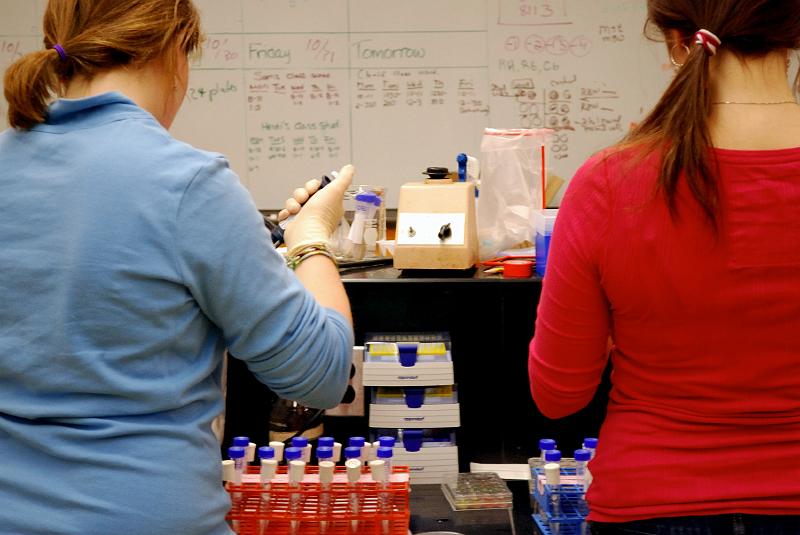
This past semester, Dr. Scott Rutherford, one of RWU's Environmental Science faculty (and resident climate change expert), had a great idea to have our science students carry their camera with them for a couple of weeks and document "Science at Roger Williams University". He ended up receiving over a 100 photos that showcase RWU science as seen through the students' eyes. Quite frankly, I think these pictures do a better job of showing what it's like to be a science major at RWU than any perfectly-lit-but-choreographed University PR photo shoot. I think we should make this an annual event.
Student's-Eye View full gallery
How could I not share a post that combines two of my favorite things - ocean science and brewing beer. I'll have to remember to take along some hops if I ever find myself on a two-month cruise.
 This evening, Christopher Hitchens, one of "The Four Horsemen", will be giving a lecture here on campus. The lecture is free and open to the public as part of our "Civil Discourse" series and as the opening to the 2009 Roger Williams University Conference on Religion and the State. The theme of this year's conference is "Islam and the West". I'm not sure how much of the conference I will attend to, but I'm headed to the Hitchens talk in an hour or so. I'm willing to bet it will be good, likely to be controversial, and probably anything but "civil". Should be fun. :)
I need to start paying more attention. How did such an incredible creature avoid my notice? How did I not see this reported over on DSN? You have to see this to believe it.
All of us lucky enough to have grown up in the greater Boston area have no doubt spent many an afternoon within the confines of that great concrete structure, the New England Aquarium - or as Rick MacPherson rightfully puts it, just "the Aquarium". Whether it was a family outing or a middle school field trip, the Aquarium has always been a favorite destination of mine. Sure, it's dark and often crowded, but the 200,000 gallon Giant Ocean Tank, penguin habitat, tidal pool touch tank, and, my new favorite, the Amazing Jellies exhibit never fail to impress.
It's incredible to think that the Aquarium is 40 years old now. Even with some recent renovations, 40 years and millions of visitors have taken their toll. But the National Trust for Historic Preservation might be able to help out some through their Partners In Preservation initiative. Through this initiative, you can vote for the Aquarium (or other Greater Boston place if you are so inclined) to be awarded a grant, which the Aquarium would use to restore some of the original architecture to how it was when its doors first opened in 1969. So, if you fondly remember walking like a penguin in your living room or telling your mom it's time for the dolphin show or running up and down the central spiral to keep up with a sea turtle or sand tiger shark or otherwise feel like supporting the Aquarium, cast your vote its way.
(thanks to Rick at MBSL&S and Jives at the New Blue for pointing this grant opportunity out)
 Please forgive me a moment of self-congratulation, but yours truly has just won the Second, Maybe Annual, MBSL&S Spring Ocean Egg Hunt hosted by that magnanimous coral conservationist, Rick MacPherson. All those years of either studying or teaching invertebrate zoology have finally paid off! Amy Johnson would be proud - and would have disowned me if I had missed Mystery Egg #4.
I've always prided myself in being somewhat of a natural historian, so I jumped at the chance to test my knowledge and sleuthing skills. Of the 15 different photos up for identification I can proudly say that I immediately knew what 11 of them were, at least generally. It took some googling to narrow them all down to species level. Mystery Eggs #7, #10 and #13 proved most difficult. With a helpful hint from Rick, #7 came into focus. #13 gave me fits and out of frustration decided they must be related to #7 - turns out my frustration served me well. #10 was easily identified to suborder, but almost impossible beyond that. Luckily, Rick gave another hint, some fellow bloggers, Eric of The Other 95% and Christie of Observations of a Nerd, ran with it, and I did nothing more than swoop in at the final second. I certainly owe them both a cold, frothy beverage or two.
Other than blogosphere bragging rights, what, you ask, do I get out of this win? How about a copy of the incredible-looking book Reef and a snazzy Coral Reef Alliance "Hawaiian" shirt. Who's stylin' now? (though the bragging rights are pretty good too)
So, thanks Rick for hosting a great contest and for the reefy swag. I will wear the shirt proudly and can't wait to flip through Reef. And for those of you not familiar with Rick's coral reef conservation work, head on over to the Coral Reef Alliance, read all about it, and maybe make a charitable donation to a worthy cause.
The university is currently in the process of adding a new addition to the Marine & Natural Science Building in which my office resides. This is a great thing as the new addition will be used to expand our shellfish hatchery program and open up space in the wet lab for the the rest of the marine science program. The problem, however, is that one of the walls in my office is an outside wall to which the addition is being attached. The end result is that everyday brings new and jarring construction activiies, sometimes to the point that you can't hold a conversation in the room. The crew even accidentally cut 6-inch-long slits through the base of the wall - wide enough that I could see daylight (seriously - I (and they) were lucky they didn't cut into a computer or wiring or somebody's foot). The other day was the absolute worse though. I have no idea what they were doing, but the entire room was vibrating - things were actually moving on the desk and shelves.
All I could think about was this:
The title of this post suggests something more grandiose than I intend to present. But it is a key question. This is just a rant of sorts that I need to get off my chest. Perhaps I shouldn't, but I need to.
A recent quiz question for my Introductory Biology class:
"What is the relationship between the number of species or groups under cladistic analysis and the number of possible cladograms?"
Student answer:
The number of species or groups under cladisitc analysis is irrelevant to the number of possible cladograms. However, as the number of species increases the number of possible cladograms increases.
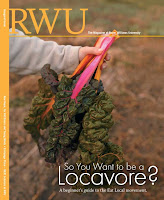 I'm very excited to announce the inaugural issue of Roger Williams University's new magazine - RWU. The old magazine, The Bridge, had stagnated and the Office of University Communications saw need to revamp and start fresh. For the first time, the University utilized a Board of Editors to help with the story and design elements of the magazine. I was asked to sit on the Board to represent the Division of Math & Science and am happy to say that the magazine came out fantastic - it's fresh, current, well-designed, and does a great job of depicting the great things associated with RWU.
By far, the majority of the credit goes to our chief editor, Brian Clark, and his staff, but, if I may toot my own horn, I enjoyed playing a role in the final product. The cover story on eating locally was my idea (as well as independently by a couple of others on the Board) and I am one of the "focus localvores" in the piece (though I am misquoted once or twice!). I was also the author of the "On the Waterfront" piece about our partnership with the New England Aquarium on page 6. All in all it has been a great experience being part of this transformation.
The magazine has been mailed out to the RWU community (Rick - did you get your copy yet?). For the rest of you, the magazine is available in pdf form from the University website. If you have a few minutes, please take a look and let me know what you think - we're starting the process already for issue #2 and would love your feedback.

Planet Forward is a PBS project being run by Frank Sesno. The topic is sustainability and energy. On this site, you will find a variety of arguments for and against our dependency on fossil fuels. As a founding partner in this project, RWU recruited nine very talented students to produce many of the videos and to contribute other content to the site.
This is a pretty cool idea and a great way to tap the power of the internet to help spread information and start dialogues on an important subject. I'm not involved with this at any level, other than the fact that RWU is one of the major players. I'm happy to to see the University involved in a project like this - it's forward-thinking and proactive - and the fact that our undergraduates played a central role makes it all the better.
As for your part, go to the site, register and rate your favorite videos. The most popular ones will appear on a national PBS special entitled “Planet Forward,” which airs at 8 p.m. ET and PT on April 15. (All top 10 media markets including NY, Boston, LA and Chicago, will air this program.)
 Even though my blogging has slowed down considerably, especially in terms of actual scientific content, I've decided to launch another blog - Cooking 4 Four. This second blog is going to be a more personal and focused space, reserved for food-related topics and issues. Food in general, and healthy, local, organic, sustainable, home cooked food in particular have become an increasingly more passionate subject in my life, especially in terms of providing a healthy lifestyle for my family. Cooking 4 Four is an attempt to capture and share that passion.
At the moment, there is just a single, "welcome" post over there, but hopefully in the coming days, it will begin to fill up and take on the identity I have envisioned for it. Hopefully "from A to Z" will shape up soon as well - perhaps the focus I give Cooking 4 Four will help me re-find the focus here. Anyways, since there's nothing new to read here, why not check out the new place. And leave a comment in the welcome post to let me know you stopped by. Thanks!
Sometimes, timing is everything. Earlier this week, I was driving with Emma to go pick up Jack at his pre-school when Emma notices a large bird in the neighbor's yard as we drove past. "Dad, I think I just saw a hawk." I took a quick look over my shoulder, and sure enough, Em had spotted a magnificent Cooper's Hawk (note: I'm pretty sure it was a Cooper's and not a Sharp-shinned, but not 100%). Not only that, but Em had caught the raptor in the middle of a meal. We're not sure, but Em thinks the hawk was feasting on a robin. Feathers were flying everywhere. I slowly backed the car up and Em and I watched the hawk take apart the smaller bird - a natural spectacle in its rawest form.
After a few minutes we needed to get going so as not to be late picking up Jack. We were hoping that the hawk would still be there when we returned, but I knew that in the 15 or so minutes we would be gone, some dog/person/car would spook the hawk away. Unbelievably though, when we drove by on our way home, the hawk was still there, and the three of us sat and watched the hawk devour its dinner. When I commented on how cool it was to be seeing this, the kids agreed, but then Jack added, "But not so cool for the robin though." Poor robin. But I like to think that witnessing these sorts of real-life events helps the kids gain a better understanding and appreciation of the natural world. And that is really cool, robin's opinion notwithstanding. 






The Musical Illusionist and Other Tales
by Alex Rose
In Defense of Food by Michael Pollan
Your Inner Fish
by Neil Shubin
The Curious Incident of the Dog in the Night-time by Mark Haddon
At the Water's Edge by Carl Zimmer
Omnivore's Dilemma by Michael Pollan
The Ancestor's Tale by Richard Dawkins
Endless Forms Most Beautiful by Sean Carroll
The Ethical Assassin by David Liss
Genesis by Robert Hazen