Folks over at the J. Craig Venter Institute have reported today in the journal
Science that they have successfully
synthesized an entire bacterium genome. An entire 580,000+ base-pair genome. From scratch. This is quite momentous as it brings the Venter team this much closer to their goal of synthesizing life
de novo.
In case you have been living in a cave for the past 10 years, Craig Venter is one of the scientists that successfully sequenced the human genome back in 1999. For the past several years, he and his team of researchers at the
JCVI have been working on creating artificial life - or rather synthetically recreating actual life. The first step towards this goal was accomplished just this past summer when Venter
et al. successfully
inserted the genome of one bacterium into another bacterium, essentially turning one species into another. Basically they showed that it was possible to insert whole genomes into another cell. The latest step just accomplished was to actually synthesize a whole genome. Next will be to try to get this genome inserted into a cell - which seems likely to happen considering their success in step 1. In fact, I would expect such an announcement in the near future.
This latest effort is quite interesting - they first sequenced the genome of
Mycoplasma genitalium and then built "small" segments of the DNA (~5,000 - 7,000 bp long) from individual nucleic acids (Phase 1). To ensure that they could identify their genome, the researchers inserted their own "watermark" sequences that differentiated it from the natural
M. genitalium genome. They also took some precautions by disabling genes for infectivity. They then assembled these "cassettes" into larger pieces of ~24,000 bp. These 24k pieces were then cloned into
E. coli for replication so there was enough DNA to work with for the next phase. Phases 2 and 3 was similar to phase 1 - this time joining the 24k fragments into 72k pieces, which were again cloned into
E. coli for amplification and sequencing, and then joining 72k fragments together to form 144k pieces, again cloned and amplified in
E. coli. Phase 4 involved joining 144k fragments to create 288k fragments. However, at this point the researchers could not obtain
E. coli clones with the 288k half-genome and had to move the operation over to the yeast
Saccharomyces cerevisiae. Once that was done, Phase 5 was a simple matter (HAH!) of joining the half-genome chunks together through
homologous recombination in yeast cells. Final sequencing showed that the team had indeed synthesized the entire
M. genitalium.
What's next? Well, step three again will be to insert this synthesized DNA into a host cells to derive fully functioning
M. genitalium. After that? How about creating an entirely novel genome from scratch? Then how about synthesizing self-assembling cell membranes to house these novel genomes? The rate at which the JCVI team is suceeding, I don't think we'll have to wait very long for true synthetic life.
 Nature reports today that the platypus genome has been sequenced by a large international team (note: subscription needed for full article). Fittingly, it seems that the genome is just as delightfully






First some antural history. The Kapok, Ceiba pentandra, is a canopy-emergent, tropical tree that can grow up to 70m (230ft) with a trunk 3m (10ft) wide. The flowers atttract bat and moth pollinators with copious nectar production. The fruits contain large amounts of cotton-like fibers that are used to disperse the small seeds through the air (similar to milkweed or dandelion dispersal). So even though the distance between Africa and South America is great, C. pentandra at least has a plausible mechanism for cross-Atlantic dispersal. The question then is, is C. pentandra found both in the Amazon and in western Africa because it was already widely spread across both continents before they separated (the vicariance hypothesis) or because it was originally found in only one location and then dispersed across the Atlantic to the other?
To answer that question, the authors used the molecular clock method. Briefly, the molecular clock method assumes that genetic mutations occur at a relatively constant rate. When two populations become separated, their genomes are free to mutate independently from one another. The longer two populations are separated, the more different we expect their genomes to be (each has acquired their own, different mutations). If the populations are not entirely separated, gene flow, the dispersal of genetic information, will homogenize the gene pool and the two sets of genomes will be relatively similar. If mutation rate is constant (and we know what it is) and we know how different two sets of DNA are, we can make a simple calculation of when the two groups became separated from one another. For example, if we know that one mutation arises every 1,000 years in a particular DNA sequence and two sets of this DNA sequence are different at 50 nucleotide locations, we know that these two groups separated from one another 25,000 years ago (we assume that each group has accrued 1/2 of the total differences - in this case each group has had enough time for 25 mutations to arise). Of course, it is much more complicated than this - sometimes the same mutation can occur independently in both lineages or a particular nucleotide may mutate and then "back-mutate" to its original (in both cases we wouldn't recognize any mutations when in fact there have been two), but the basic concept remains the same.
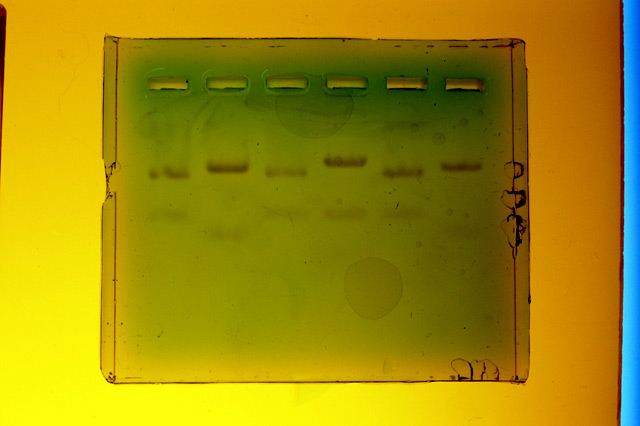
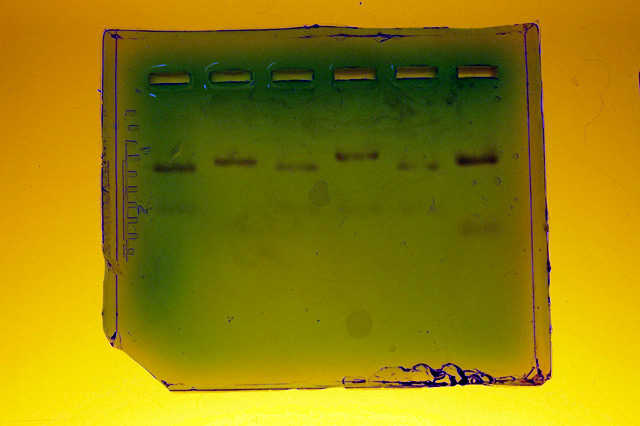
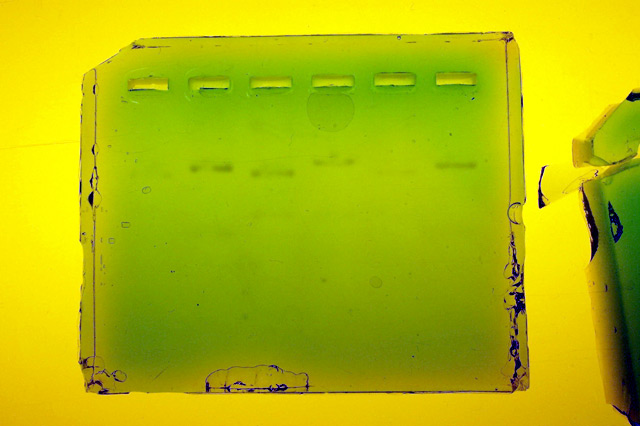
For this study, leaf tissue was collected from C. pentandra individuals from Western Africa, Central America, South America, and Puerto Rico. From these samples, stretches of nuclear and chloroplast non-coding DNA were sequenced. The nuclear sequences that were sequenced were for a subset of the internal transcribed spacers (ITS) found between the genes that encode ribosomal subunits. The sequenced chloroplast DNA was from intergenic spacers found between some photosynthesis genes. Basically, these areas are used for two main reasons:
1. They are highly variable
They do not encode any functional protein so the sequences are essentially freed from the pressures of natural selection. Since there are no selective pressures on them, mutations that arise in the sequence are not weeded out and over time the number of mutations build up. Thus, two groups of organisms that have been separated will build up different sets of mutations in these regions relatively quickly, making these regions useful, using the molecular clock method described above, when looking at phylogenetic relationships of closely related groups (usually at the species level or, as in this case, at the population level within a species).
2. They are easily located
The spacers are found flanking very important genes - those that are responsible for making ribosomes and for carrying out photosynthesis. These important genes are generally less variable as mutations in their sequences tend to be functionally disruptive and are thus naturally selected out. The sequences for these genes are therefore generally stable and are "easy" to locate in genomes. Biologists use these highly-conserved, known sequences as starting and ending points for locating the more variable, unknown sequences of the spacers between them.
Once the authors sequenced the spacers, they could examine how the sequences differed across the geographic range of the species. By using an amalgam of previously published values of mutation rates, and erring on the conservative side, the authors hypothesis was that if African and Neotropical populations of C. pentandra have been isolated since the breakup of Gondwana the ITS nucleotide sequences should be at least 7% different and the chloroplast spacers should be at least 19% different.
Those are the expected values under the vicariance hypothesis. When the authors tested this hypothesis, they observed that the ITS sequence divergence was less than 0.4% and that there was essentially no divergence in the chloroplast sequences (the only variation was found in one cluster in western Ecuador). The observed values were significantly lower than the expected values. This means that the African and Neotropical populations have not been isolated for 100 million years - kapok trees did not cross the Atlantic not as passengers on the drifting continents. The low level of genetic divergence between the geographic areas suggests that more recent (and thus long-range) dispersal is responsible for the kapok tree's geographic pattern. The authors suggest that cottony seed fibers could allow the seeds to be transported long distances via wind currents. Alternatively (or contemporaneously) floating kapok seeds may be dispersed via ocean currents.
But where did the great kapok tree originate? Africa or South America? Most cross-Atlantic dispersals are assumed to have been westerly - from Africa to the New World. However, the authors suggest that C. pentandra did it the other way - though, based solely on the suggestions in this paper, I am not convinced (whatever that is worth!). Regardless of which direction the kapok tree went, it is clear that it crossed the Atlantic relatively recently via seed dispersal, not through an ancient vicariance event.
Citation: CHRISTOPHER W. DICK, ELDREDGE BERMINGHAM, MARISTERRA R. LEMES, ROGERIO GRIBEL (2007) Extreme long-distance dispersal of the lowland tropical rainforest tree Ceiba pentandra L. (Malvaceae) in Africa and the Neotropics. Molecular Ecology (OnlineEarly Articles). doi:10.1111/j.1365-294X.2007.03341.x