Showing posts with label Invertebrates. Show all posts

Thursday, April 16, 2009

How do you like your eggs?

Please forgive me a moment of self-congratulation, but yours truly has just won the Second, Maybe Annual, MBSL&S Spring Ocean Egg Hunt hosted by that magnanimous coral conservationist, Rick MacPherson. All those years of either studying or teaching invertebrate zoology have finally paid off! Amy Johnson would be proud - and would have disowned me if I had missed Mystery Egg #4.

I've always prided myself in being somewhat of a natural historian, so I jumped at the chance to test my knowledge and sleuthing skills. Of the 15 different photos up for identification I can proudly say that I immediately knew what 11 of them were, at least generally. It took some googling to narrow them all down to species level. Mystery Eggs #7, #10 and #13 proved most difficult. With a helpful hint from Rick, #7 came into focus. #13 gave me fits and out of frustration decided they must be related to #7 - turns out my frustration served me well. #10 was easily identified to suborder, but almost impossible beyond that. Luckily, Rick gave another hint, some fellow bloggers, Eric of The Other 95% and Christie of Observations of a Nerd, ran with it, and I did nothing more than swoop in at the final second. I certainly owe them both a cold, frothy beverage or two.

Other than blogosphere bragging rights, what, you ask, do I get out of this win? How about a copy of the incredible-looking book Reef and a snazzy Coral Reef Alliance "Hawaiian" shirt. Who's stylin' now? (though the bragging rights are pretty good too)

So, thanks Rick for hosting a great contest and for the reefy swag. I will wear the shirt proudly and can't wait to flip through Reef. And for those of you not familiar with Rick's coral reef conservation work, head on over to the Coral Reef Alliance, read all about it, and maybe make a charitable donation to a worthy cause.

Saturday, October 18, 2008

Oldest flying insect...

...found about 10 minutes from my house! How cool is that?

Tuesday, October 14, 2008

Chocolate Molluscs

What do you get the molluscophile in your life? Chocolate oysters from the Wellfleet Candy Company, of course! Molded from a real Wellfleet oyster, these gourmet chocolates are the latest rage in invertebrate haute cuisine.

I haven't had one of these yet, but the Boathouse, Mayo Beach, and West Side varieties sound delicious.

Wednesday, August 13, 2008

Big Bugs!

A couple photos from our visit to the Big Bugs exhibit at The Garden in the Woods:


Tuesday, August 05, 2008

Not your ordinary mollusc

While going through my regular evening ritual of perusing the sites on my blogroll (I always start at the bottom and work my way up for some reason - I don't really know why), I came across the latest post by Emile over at The World We Don't Live In. This post is about the ever-so-rare phenomenon of vertebrates mimicking invertebrates. Now, while that is an interesting topic in its own right, what struck me as absolutely fascinating was the mention of a creature I had no idea even existed - the Indonesian mimic octopus, Thaumoctopus mimicus. (note: the creature is absolutely fascinating, not the fact that I had not heard of it - though I am surprised that such a critter had escaped my attention until now).

The video below does a good job of showing off this incredible quick-change artist. I'm starting to see why so many people think molluscs are so damn cool.

Sunday, July 20, 2008

Thursday, July 10, 2008

Cuttlefish babies!

In case you missed it, Kevin Z was the winner of the mystery photo contest - he correctly guessed identified those inch-long black things as cuttlefish egg cases. Congrats, Kevin! Your hard-earned loot is in the mail (or, rather, will be tomorrow).

Specifically, those were the egg cases of the common cuttlefish, Sepia officinalis, one of the organisms currently in residence here at RWU. One of our undergrads is working on more effective and efficient ways of breeding and raising them. The black color comes from ink that the female injects into each egg case.

The eggs hatched over this past weekend - 88 in total. Each hatchling is a tiny, yet fully formed cuttlefish that feeds, changes color, and inks if disturbed. They're very cute (for a mollusc).

Some pics of 2-day old cuttlefish (I'll try to get a better, close-up later when they're a little bigger). Each baby is about 1.5cm or so:


Here are some older, bigger cuttles (approx. 15-20 cm):


Wednesday, June 11, 2008

Garden Inverts

(click on images for larger view)

Wolf Spider with egg case (family Lycosidae; female)


Aphids (Uroleucon sp?) on Heliopsis

Tuesday, May 06, 2008

Circus of the Spineless

Kevin Zelnio has the latest edition of the Circus of the Spineless up at Deep Sea News. Go check it out.

Thursday, May 01, 2008

Probably doesn't taste like chicken

Drop what you're doing and go check out Coral Week at Deep Sea News - everything you never wanted to know about those cnidarious crusteose critters.

Better yet, start with ChrisM's post about echinoderms that eat corals.

Sunday, April 20, 2008

Slowly, but surely

Littorina littorea - Paine's Creek Beach, Brewster, MA

Saturday, April 19, 2008

Weekly Urchin: Pedicellariae

A few weeks back I offered up the sea urchin feeding mechanism, Aristotle's Lantern, as a reason why echinoderms are way cooler than molluscs. In the comments of that post, JasonR of CephaloPodcast suggested that if I wanted to impress them I should write something about pedicellariae. Now, I'm not one to kowtow to the demands of the mollusc camp, but pedicellariae are rather cool and certainly worth a weekly urchin post.

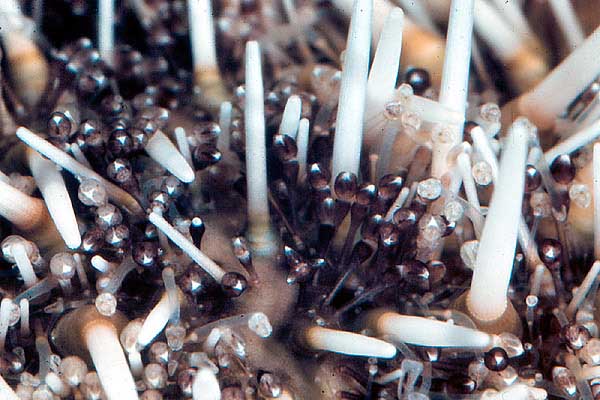
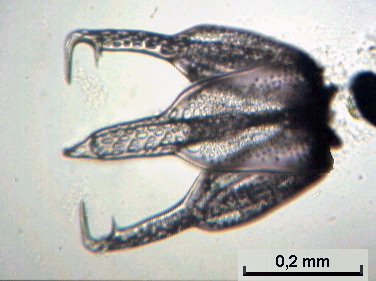
Pedicellariae are small, stalked appendages that are scattered among the spines and tube feet of some sea stars and urchins. The head of each pedicellaria is akin to a three-piece claw. This "claw" is used for a variety of functions, including defense, food capture, and the removal of encrusting critters (e.g. parasites, algae, settling larvae). Some echinoderm species may even use their pedicellariae to hold onto pieces of algae or debris as a form of camouflage - though urchins will also use their tube feet for this.


When first described in the 18th century, pedicellariae were thought to be parasites on the tests of sea urchins and were assigned to three species in the genus Pedicellaria. A century later it was realized that these parasite "species" were actually specialized urchin/sea star structures that differed in form - tridentate, triphyllous , globiferous - each with a different function and found in different numbers, combinations, and locations depending on the species. Globiferous pedicellariae are particularly nasty - sharp, hooked, and poisonous. In some urchins, like the "flower" urchins of the genus Toxopneustes, the pedicellariae are more prevalent, and more injurious, than the spines.


As it is getting late, I'll leave you with this brief video of pedicellariae in action.

Tuesday, April 08, 2008

Help a young invertaphile out

I got this wonderful email the other day. It's wonderful on several levels - first, it's proof that someone actually reads this thing; second, the author, clearly an intelligent and sane individual, rightfully sees the "inherent" greatness of Aristotle's Lantern; and third, the author is a college-bound student that already has the drive and interest to work with inverts - and not your standard inverts either, but the Tardigrada (bonus video here). I would like to do what I can to help this student out, but all I could offer was that she contact the biology faculty at Mt. Holyoke. She agreed to let me post her request here in hopes that someone else might be able to offer more. Please take a read and leave any suggestions in the comments.

This is totally out of the blue, but I stumbled upon your argument for the wondrousness of the aristotle's lantern in Echinoderms. While I always thought this structure to be inherently greater than the radula, I found your vehemence intriguing. I took it upon myself to find out who you were, and upon seeing that you taught in Massachusetts, a thought occurred. I will be attending Mount Holyoke college in South Hadley, MASS beginning next year and am intensely interested in invertebrates (namely the Tardigrade). If you know of any research or intern positions for those with no college experience under their belt, I would be eternally grateful to obtain such information. I may be starting in the spring term (in 2009), so anything starting then, or even as soon as the summer, would be ideal.

An olive branch...

This was shown today during a faculty-candidate seminar for our very cool joint position with the New England Aquarium. I have to admit, no sea urchin could do this...perhaps not all molluscs are totally uncool.

Octopus escaping through a 1 inch 2.5 cm hole

Wednesday, April 02, 2008

Circus of the Spineless

Welcome to the March edition of the Circus of the Spineless. Yeah, yeah, I know it's April already....give me a break. If Major League Baseball wants to say that the Red Sox season began a week ago, I can say this is the March edition.

Actually, this moth's celebration of all things spineless couldn't have come at a better time. With the blogosphere currently embroiled in the Invertebrate Battle Royal, what better time to bring us all together in the spirit of peace and harmony, united behind our wonder and love for the entirety of invertebrate diversity, to stand arm in arm, putting our petty differences aside to celebrate the natural world to stick it the mollusc camp and prove once and for all the superiority of the echinoderms and all things unmolluscan (well, maybe not all things unmolluscan)? What can I say, I'm a divider, not a unifier. Forces are being divvied up and what was once a simple Holothoroidea vs. Mollusca battle is becoming a war between the all-mighty, wicked cool deuterostomes and the pathetic protostomes. Yes, I said wicked cool. Choose your allegiances wisely - no one likes a turncoat.

With a dearth of submissions a day ago, this was looking like it was going to be an all-urchin carnival, but a flurry of emails over the past 24 hours has beefed it up considerably, though predictably heavy on the arthropod front. It is possible that some submissions were inadvertently dumped by my spam filter - if so, I apologize. Unless they were about molluscs. On an only tangentially related note, in honor of Gibbon Jockey, I'd like to nominate the Indiana men's basketball team as the spineless champion of the month.

Now on to the Circus.

Phylum Echinodermata:

  • Kevin Zelnio, in a moment of sanity that he later renounces, gives us a great post about how the remarkable ability of sea cucumbers to quickly change the stiffness of their skin by rearranging collagen nanofibers has inspired some far-thinking scientists to use this biological marvel to help treat Parkinson's. How cool is that? Man, those echinoderms never cease to amaze.


  • In anticipation of a short vacation to the Domincan Republic, yours truly offered up a post on the remarkable sea urchin Diadema antillarum and the fate that has befallen it. And speaking of ultra-cool echinoderms, you can also find my foray into the Battle Royal with a brief description of the coolest feeding structure in all of Animaldom. And while I'm self-promoting, check out this urchin-themed music video I found. Does calamari have such a thing? I think not!


  • Phylum Urochordata:
  • Jumping in on the deuterostome side of the war is Miriam at The Oyster's Garter (what an unfortunately blog name) with her delineation of all the cool things about tunicates
  • .

    Phylum Cnidaria:
  • Reporting on a phylum only slightly less cool than Echinodermata (but light-years ahead of those bilateral molluscan schmucks), Rick of Malaria, Bedbugs, Sea Lice, and Sunsets reports on yet another threat to the increasingly-vulnerable corals - other corals.


  • Phylum Annelida:
  • Budak needs some help IDing this polychaete. Nice photo.


  • Phylum Endoprocta:
  • Christopher at Catalogue of Organisms gets his first look at the endoprocts. Personally, I haven't had the privilege, but based on Christopher's description I can tell they're way cooler than molluscs.


  • Phylum Arthropoda:
    Class Insecta
  • Duncan has a very nice journal-like account of a dragonfly expedition - part 1, part 2. The description and details provided by Duncan make you feel like you're there. And best of all, not a snail in sight!


  • Both Ed at Not Exactly Rocket Science and John at a DC Birding Blog discuss how moths can remember lessons learned as a caterpillar. Yes, that's right, moths retain memories from their larval stages.


  • Doug at Gossamer Tapestry makes a case for considering addding the Swamp Metalmark to the endangered species list.


  • RPM at evolgen explains that sleep-deprived male Drosophila are less interested in sex than their well-rested counterparts. The question I have though is how does one deprive fruit vinegar flies of sleep?


  • Susannah (AKA Wanderin' Weeta) offers up some tips on photographing carpet beetles and wonders if they get hangovers. To quote Susannah from her email, "Not a mollusc, fortunately." See, Wanderin' Weeta gets it.


  • Budak offers us two poetic insect posts. First on the Diptera-like Bembix wasp and another on the softer side of assassin bugs. You should definitely follow the image links to his Flickr account for some wonderful images.


  • Rurality gives us some pics of and musings on the Hummingbird Clearwing Moth. Must be nice to have insects flitting about flowers this time of year. Tomorrow's forecast here is for a balmy 37oF!


  • Jenn at Invasive Species Weblog wisely stays clear of sending me any of her mussel posts. Instead, she paraphrases one of my favorite Good Will Hunting lines in a report on the Apple Moth and its likely lack of invasive potential here in the U.S. She also sent along a photo of a member of one of the coolest groups of insects - the Prodoxidae or yucca moths (my grad work was on the population genetics of yuccas and yucca moths, so I may be a bit biased)


  • Class Arachnida
  • Troy over at Ramblings Around Texas has a brief introduction to spiders in general and wolf and orb-weaving spiders in particular. Be sure to click on the images for some stunning shots.


  • Class Malacostraca
  • Ed joined the Great Invertebrate War with his post on the phenomenal vision of the mantis shrimp. I guess mantis shrimp are pretty cool...in a thuggish, Whitey Bulger sort of way - check out the video at the end of Ed's post to see a mantis shrimp terrorizing fellow crustaceans. Not just spineless, but heartless, I tell you.


  • Andrea was buzzing about her garden during the vernal solstice equinox this year, but only managed to find some roly-poly pill bugs. For some reason, these guys have always grossed me out. I can't even imagine carrying them around in my pockets.


  • Phylum Mollusca:
  • Kevin Z has some drivel about snail mucus as a wonder cure for wrinkly skin. See, aren't molluscs just the coolest? Pah-lease.


  • Budak highlights how to catch octopus in Singapore. So much for the supposed brainiacs of the spineless. Stupid molluscs. (note: as always with Budak's posts, be sure to follow the links for some nice photos)


  • In what I can only fathom was an attempt to be true to his blog's title (why else would an intelligent person blog about molluscs?), Christopher at the Catalogue of Organisms, gives us a description of those quirky gastropods, the struthiolariids, aka "ostrich foot shells". Man, nothing cooler than snails named after, yet lacking any resemblance to, the appendages of large flightless birds. If this doesn't prove Craig's case, I don't know what will.


  • Well, that's all folks. Hopefully, I've managed to do my part in the Great Invertebrate War and convinced all of you how uncool molluscs are. If not, you can send your rebuttal to the April edition of the Circus to be hosted by Deep Sea News - you're sure to find a sympathetic ear there. On a another note, I'll be hosting the April edition of Linnaeus' Legacy in a few days or so, so send me your posts!

    Monday, March 31, 2008

    RFP: Circus of the Spineless

    I'm making one last request for posts for this month's Circus of the Spineless. I should have it up in the next couple of days, but I have relatively few submissions. Please send all your invertebrate-themed writings to me at jim{dot}lemire{at}gmail{dot}com

    Please note that Echinoderm posts will be given top priority, followed, in order, by posts on Cnidaria, Ctenophora, Annelida, Arthropoda, Platyhelminthes, Porifera, Nemertea, Chaetognatha, Sipuncula, Bryozoa, Tardigrada, Onychophora, Brachiopoda, any non-Mollusca phylum not already mentioned, and finally, if there is room and I have time for them, the tragically uncool Mollusca.

    Also, I noticed over the weekend that at least one CoS submission was delivered to my spam folder. I normally do not check my spam and erase it all unseen, so it is possible that some submissions have been unwittingly deleted. I generally send an email confirming that I received your submission, so if you sent something to me and I did not reply, please resend. Thanks.

    Friday, March 28, 2008

    Echinoderms are so much cooler than Molluscs (or why Craig McClain is off his rocker)

    So, I go away on vacation for a few days and upon my return, as I am catching up on all my favorite blogs, I'm blindsided by the outbreak of war. And not your typical war either, but a vicious series of unprovoked and uncalled for attacks (Ok, maybe it is like a typical war). It seems that Dr. Craig R. McClain of Deep Sea News has thrown down the gauntlet by making a series of scathing posts concerning his erroneous belief that molluscs are somehow cooler than echinoderms. Now I just cannot stand for this. Especially after reading about how the molluscan radula is deemed one of the reasons this phylum is so cool compared to the echinodermata. I'm sorry, but Craig must not be thinking clearly. The radula? A spiky ribbon makes molluscs cool? Please. Don't waste your time, Craig. If we're going to be comparing feeding apparatuses (apparati?) of molluscs and echinoderms, your precious mantle-wearing protostomes don't stand a chance. Echinoderms utilize one of, if not the, coolest feeding mechanism in the animal kingdom - Aristotle's Lantern.

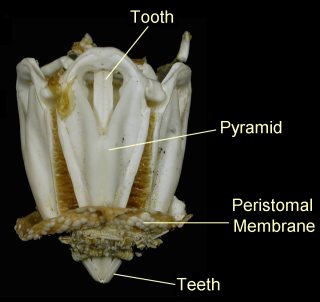
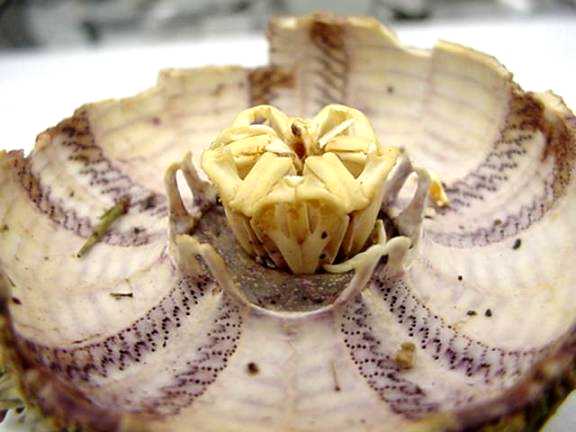
    First off, few structures in living organisms have as cool a name as "Aristotle's Lantern" - this structure was described by Aristotle in his Historia Animalium written around 343 BC. Second off, it is an "architectural marvel"1, consisting of a complex of "50 skeletal elements and worked by 60 muscles"2. The structure contains a set of five calcareous pyramids, each with a canal where a long, sharp tooth lies and protrudes outside the oral cavity. The teeth can be protracted and spread apart through the constriction muscles that push the entire lantern orally. Retraction of the "jaw" involves another set of muscles. Yet other muscles can produce swivel and rocking movement of the teeth and lantern apparatus. I'm sorry, but a radula cannot compete with this.

    It is hard to comprehend the complexity and coolness of Aristotle's Lantern without seeing one in person, but here are a few images to help you:


    Sorry Craig, but you've got no case here. Get that weak-ass radula crap outa my house.

    Friday, March 21, 2008

    Weekly Urchin: Friday Dial Stopper edition

    Back from the D.R. - great time - photos to come (hopefully) - battling the flu now unfortunately. More next week. Until then, enjoy this combo urchin-dial stopper offering. And no, that is not me with a bad haircut.

    Tuesday, March 11, 2008

    Weekly Urchin - Dominican Republic edition


    In anticipation of Linda's and my vacation to the Dominican Republic in a few days, I give you Diadema antillarum, the long-spined sea urchin. This urchin is a keystone herbivore on coral reefs throughout the Caribbean and one I hope to see during our vacation.

    This particular species was once a dominant part of coral reef communities. However, a catastrophic die-off in 1983, the result of an unknown pathogen, resulted in an over 97% mortality rate Caribbean-wide - the most severe mass mortality ever recorded for a marine organism. The disappearance of D. antillarum from the reefs lead to the proliferation of macro-algae which quickly overtook the coral reefs. This unchecked algal cover resulted in coral die-off and prevented new coral recruitment. The result was an overall deterioration of reef communities. Although there have been reports of localized D. antillarum and subsequent coral reef recovery (Edmunds and Carpenter 2001), populations remain low even decades later (Lessios 2005 - pdf). Continued research and coral reef restoration using reared and/or transplanted D. antillarum are currently underway.

    Changing tacks a bit, below is a stunning video of D. antillarum development from Diadema.org. The video is a bit long, but it comes complete with a soundtrack by Enya (I believe) and contains amazing footage of a metamorphosing larva - if nothing else, you need to watch for this (about a third to half-way in).


    How many legs does an insect have?

    Not a question one would think one would have to ask an undergraduate. Especially, an undergraduate majoring in biology.

    However, if such a question does need to be asked, one would like to think that the answer would not be:
    "Eight? More than eight? I don't know."

    EIGHT!?!?!?!?!?! MORE THAN EIGHT?!?!?!?!?! I DON'T KNOW!?!?!?!?!?!?!

    I'm pretty sure my 4-year old knows this answer. And if he doesn't, my 7-year old certainly does.

    Hell in a hand basket, people. Hell in a hand basket.