Showing posts with label Weekly Urchin. Show all posts

Friday, May 30, 2008

Weekly Urchin - what's in a name?

Chris at Echinoblog, coupled with the National Spelling Bee, gave me the inspiration for this week's urchin post.

Now, if you haven't heard, the green sea urchin, Strongylocentrotus droebachiensis, is my favorite urchin (yes, that's right, I said favorite urchin). But what, exactly, is the meaning of that name (certainly one of the longest species names out there)? This info was not easy to find, but with a little digging, this is what I've come up with:

First the classification:
Phylum Echinodermata
Class Echinoidea
Order Echinoida
Family Strongylocentrotidae
Genus Strongylocentrotus
Species droebachiensis

Now the various etymological roots:

echino - this was actually trickier than I thought it would be - from what I can tell the Greek ekinos means either 'hedgehog', 'sea urchin', and/or 'spiny'.

derma is Greek for 'skin'.

For Echinodermata, 'spiny skin' is the translation usually given, which makes sense. I like 'hedgehog skin' myself. Not so sure about 'sea urchin skin' to describe a group that contains the sea urchins.

Strongylo: from the Greek strogkylos meaning 'round'

centrotus: from the Greek kentrotos meaning 'spiked' (perhaps especially in reference to a type of spiked buckler)

droebachiensis: refers to Drobak, Norway where the species was first described

I guess this means that a literal translation would be something like 'spiky, round thing from Drobak'. Northern green sea urchin sounds better.

Thursday, May 15, 2008

Weekly Urchin: Crash and Burn Edition

Click on image to enlarge
Data from the National Marine Fisheries Service

How's this for a poster child of overfishing and mismanagement? (actually, to be fair, I imagine that the sudden rise in urchin demand in 1987 took the fisheries folks by surprise and by the time they implemented a management plan, it was already too late.)

Friday, May 02, 2008

Weekly urchin - new toy edition

Part of my job as coordinator of the Undergraduate Center for Marine Life Sciences is to purchase equipment that could be used by students and faculty for research. The newest edition to the Center is a Sea & Sea DX-1G digital underwater camera and strobe. It seems on first inspection to be a marvelous piece of equipment. (Thanks, Rick, for using your power and influence to coerce some useful camera feedback from your "peeps" for me)


The second the battery finished charging, I grabbed the camera and headed down to the RWU wetlab to try it out. I must say that I'm really impressed with the quality of the images this camera takes, especially since these test shots were taken with me just sticking the camera into a bunch of tanks, hoping I was focusing on something, and using only the built-in flash instead of the big strobe. With some fine-tuning I think this will take some phenomenal shots out in the field.

First up, Strongylocentrotus droebachiensis, of course:

Here's an oyster toadfish trying to hide:

Apparently tautog like to snuggle with toadfish:

Lined seahorse:

Fire shrimp:

Baby Juvenile jawfish:

The clownfish thought I was going to feed them:

Saturday, April 19, 2008

Weekly Urchin: Pedicellariae

A few weeks back I offered up the sea urchin feeding mechanism, Aristotle's Lantern, as a reason why echinoderms are way cooler than molluscs. In the comments of that post, JasonR of CephaloPodcast suggested that if I wanted to impress them I should write something about pedicellariae. Now, I'm not one to kowtow to the demands of the mollusc camp, but pedicellariae are rather cool and certainly worth a weekly urchin post.

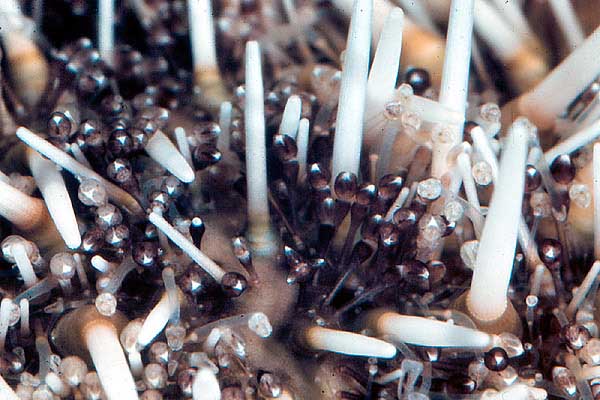
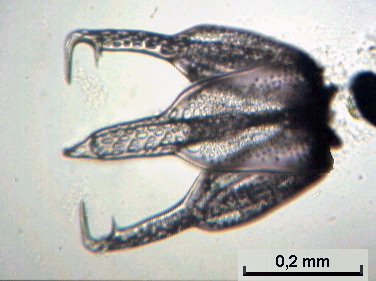
Pedicellariae are small, stalked appendages that are scattered among the spines and tube feet of some sea stars and urchins. The head of each pedicellaria is akin to a three-piece claw. This "claw" is used for a variety of functions, including defense, food capture, and the removal of encrusting critters (e.g. parasites, algae, settling larvae). Some echinoderm species may even use their pedicellariae to hold onto pieces of algae or debris as a form of camouflage - though urchins will also use their tube feet for this.


When first described in the 18th century, pedicellariae were thought to be parasites on the tests of sea urchins and were assigned to three species in the genus Pedicellaria. A century later it was realized that these parasite "species" were actually specialized urchin/sea star structures that differed in form - tridentate, triphyllous , globiferous - each with a different function and found in different numbers, combinations, and locations depending on the species. Globiferous pedicellariae are particularly nasty - sharp, hooked, and poisonous. In some urchins, like the "flower" urchins of the genus Toxopneustes, the pedicellariae are more prevalent, and more injurious, than the spines.


As it is getting late, I'll leave you with this brief video of pedicellariae in action.

Friday, March 28, 2008

Echinoderms are so much cooler than Molluscs (or why Craig McClain is off his rocker)

So, I go away on vacation for a few days and upon my return, as I am catching up on all my favorite blogs, I'm blindsided by the outbreak of war. And not your typical war either, but a vicious series of unprovoked and uncalled for attacks (Ok, maybe it is like a typical war). It seems that Dr. Craig R. McClain of Deep Sea News has thrown down the gauntlet by making a series of scathing posts concerning his erroneous belief that molluscs are somehow cooler than echinoderms. Now I just cannot stand for this. Especially after reading about how the molluscan radula is deemed one of the reasons this phylum is so cool compared to the echinodermata. I'm sorry, but Craig must not be thinking clearly. The radula? A spiky ribbon makes molluscs cool? Please. Don't waste your time, Craig. If we're going to be comparing feeding apparatuses (apparati?) of molluscs and echinoderms, your precious mantle-wearing protostomes don't stand a chance. Echinoderms utilize one of, if not the, coolest feeding mechanism in the animal kingdom - Aristotle's Lantern.

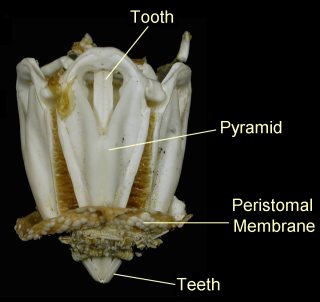
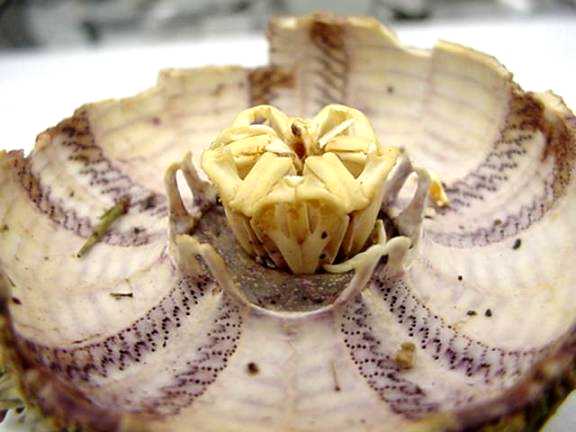
First off, few structures in living organisms have as cool a name as "Aristotle's Lantern" - this structure was described by Aristotle in his Historia Animalium written around 343 BC. Second off, it is an "architectural marvel"1, consisting of a complex of "50 skeletal elements and worked by 60 muscles"2. The structure contains a set of five calcareous pyramids, each with a canal where a long, sharp tooth lies and protrudes outside the oral cavity. The teeth can be protracted and spread apart through the constriction muscles that push the entire lantern orally. Retraction of the "jaw" involves another set of muscles. Yet other muscles can produce swivel and rocking movement of the teeth and lantern apparatus. I'm sorry, but a radula cannot compete with this.

It is hard to comprehend the complexity and coolness of Aristotle's Lantern without seeing one in person, but here are a few images to help you:


Sorry Craig, but you've got no case here. Get that weak-ass radula crap outa my house.

Friday, March 21, 2008

Weekly Urchin: Friday Dial Stopper edition

Back from the D.R. - great time - photos to come (hopefully) - battling the flu now unfortunately. More next week. Until then, enjoy this combo urchin-dial stopper offering. And no, that is not me with a bad haircut.

Tuesday, March 11, 2008

Weekly Urchin - Dominican Republic edition


In anticipation of Linda's and my vacation to the Dominican Republic in a few days, I give you Diadema antillarum, the long-spined sea urchin. This urchin is a keystone herbivore on coral reefs throughout the Caribbean and one I hope to see during our vacation.

This particular species was once a dominant part of coral reef communities. However, a catastrophic die-off in 1983, the result of an unknown pathogen, resulted in an over 97% mortality rate Caribbean-wide - the most severe mass mortality ever recorded for a marine organism. The disappearance of D. antillarum from the reefs lead to the proliferation of macro-algae which quickly overtook the coral reefs. This unchecked algal cover resulted in coral die-off and prevented new coral recruitment. The result was an overall deterioration of reef communities. Although there have been reports of localized D. antillarum and subsequent coral reef recovery (Edmunds and Carpenter 2001), populations remain low even decades later (Lessios 2005 - pdf). Continued research and coral reef restoration using reared and/or transplanted D. antillarum are currently underway.

Changing tacks a bit, below is a stunning video of D. antillarum development from Diadema.org. The video is a bit long, but it comes complete with a soundtrack by Enya (I believe) and contains amazing footage of a metamorphosing larva - if nothing else, you need to watch for this (about a third to half-way in).


Saturday, February 23, 2008

Weekly Urchin: Dreamlines

I've somehow managed to completely slack on last week's "Weekly Urchin" post. So much for giving them the respect they deserve. Oh well. To make up for it, please enjoy these lovely pieces of urchin art - generated by a program called Dreamlines created by Leonardo Solaas. (Hat tip to Kevin Z. for bringing Dreamlines to my attention).


Friday, February 08, 2008

Weekly Urchin: Sea Urchin 101

Despite what some people think, sea urchins are not morally reprehensible. Sure, they've got sharp, pointy spines and a predilection for destroying kelp beds, but they're not bad characters. They're just misunderstood. Well, I think it's time sea urchins got more respect and no longer crept in the shadows of their echinoderm brethren - the popular, good-looking sea stars (yes, 'sea stars', not 'starfish'), the mysterious and sought-after sand dollars and the quirky, fun-loving sea cucumbers (what about the crinoids you ask? Forget them - they're just weird).

So, in an attempt to raise much deserved good will toward these dark and brooding echinoids, and in the spirit of MBSL&S's That's A Moray Monday, DSN's TGIF series, and Pharyngula's Friday Cephalopod, I've decided to take it upon myself to offer a weekly urchin post.

I'll start with some sea urchin basics...

Sea urchins are spiny marine invertebrates that comprise, along with sand dollars, sea biscuits, and heart uchins the Class Echnoidea within the Phylum Echinodermata. Sea urchins differ from the other echinoids by having a more-or-less spherical body-plan and are thus referred to as "regular" or "globose" echinoids. Like other echinoderms, sea urchins utilize a hydraulic system of tube feet for locomotion and display pentameral or five-rayed symmetry - most clearly delineated in their test (a.k.a. shell). Although relatively small (generally less than 15 cm in diameter), some species can have spines over 20 cm long. With somewhere around 800 extant species, sea urchin are a cosmopolitan critter - found from the Arctic to the Antactic and from the intertidal zone to the deep-sea.

External anatomy
Sea urchin tests are are comprised of calcium/magnesium carbonate plates, specifically, five alternating pairs of columns of ambulacral and interambulacral plates. The ambulacral plates contain pores through which the tube feet protrude. Both kinds of plates have tubercles - ball-and-socket type spine attachments (urchin spines are capable of moving somewhat like your index finger around the first knuckle). The test and spines are all covered in a thin epidermis.


The oral surface of an urchin is on the bottom where its five teeth can be found (contained within "Aristotle's lantern", one of nature's most impressive feeding structures - more on this in a later post). The aboral surface is on top and contains the anus, surrounded by aptly-named anal plates, which are in turn surrounded by genital plates, each of which contains a gonadopore, through which gametes are released. One of the gonadal plates (known as the sieve plate) contains the madreporite - the structure through which water is drawn to power the water vascular system, the hydraulic system used by echinoderms for locomotion.


General Ecology
Sea urchins are epifaunal, using their Aristotle's lantern to graze upon algae and sessile organisms. Their spines are used for protection against predators (otters, fish, sea birds). Some urchin species have specialized spines that are capable of injecting venom that causes intense pain. Urchins can be voracious eaters and, if their numbers are unchecked, a population of urchins can completely strip an area of vegetation, resulting in a seriously-altered ecosystem generally termed an "urchin barren". Likewise if urchin numbers crash, the resulting algal growth can severely alter the local ecosystem.


Ok, it's quite late, so that's all for now. More on these lovely, non-evil creatures next week.