 A few weeks back I offered up the sea urchin feeding mechanism, Aristotle's Lantern, as a reason why echinoderms are way cooler than molluscs. In the comments of that post, JasonR of CephaloPodcast suggested that if I wanted to impress them I should write something about pedicellariae. Now, I'm not one to kowtow to the demands of the mollusc camp, but pedicellariae are rather cool and certainly worth a weekly urchin post.
Pedicellariae are small, stalked appendages that are scattered among the spines and tube feet of some sea stars and urchins. The head of each pedicellaria is akin to a three-piece claw. This "claw" is used for a variety of functions, including defense, food capture, and the removal of encrusting critters (e.g. parasites, algae, settling larvae). Some echinoderm species may even use their pedicellariae to hold onto pieces of algae or debris as a form of camouflage - though urchins will also use their tube feet for this.
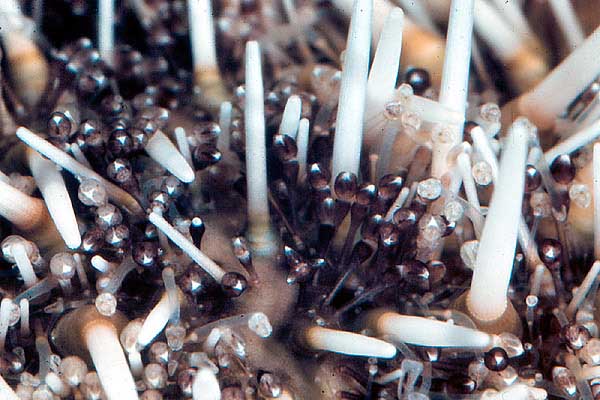

When first described in the 18th century, pedicellariae were thought to be parasites on the tests of sea urchins and were assigned to three species in the genus Pedicellaria. A century later it was realized that these parasite "species" were actually specialized urchin/sea star structures that differed in form - tridentate, triphyllous , globiferous - each with a different function and found in different numbers, combinations, and locations depending on the species. Globiferous pedicellariae are particularly nasty - sharp, hooked, and poisonous. In some urchins, like the "flower" urchins of the genus Toxopneustes, the pedicellariae are more prevalent, and more injurious, than the spines.

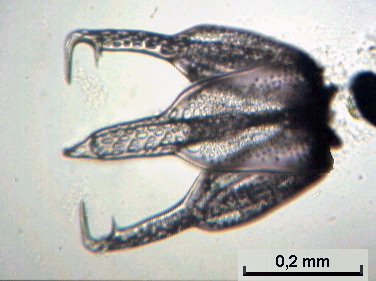

As it is getting late, I'll leave you with this brief video of pedicellariae in action.
I love this....one of my high school marine science students found these in wetmounts of sea urchin eggs we were following after fertilization. I had never seen one before but after thinking about them and looking for a "parasitic worm" on sea urchins I started checking out the structure of tube feet and so I thank you very much for the video and the easy identification of our "worms" from your nicely done drawings. I'll have to learn more about them, why they are shed, how long the "live" in isolation, and what they eat other than sea urchin eggs!
ReplyDeletesimply magnificent. Nice post on a relatively unknown structure.
ReplyDelete