So, in an attempt to raise much deserved good will toward these dark and brooding echinoids, and in the spirit of MBSL&S's That's A Moray Monday, DSN's TGIF series, and Pharyngula's Friday Cephalopod, I've decided to take it upon myself to offer a weekly urchin post.
I'll start with some sea urchin basics...
 Sea urchins are spiny marine invertebrates that comprise, along with sand dollars, sea biscuits, and heart uchins the Class Echnoidea within the Phylum Echinodermata. Sea urchins differ from the other echinoids by having a more-or-less spherical body-plan and are thus referred to as "regular" or "globose" echinoids. Like other echinoderms, sea urchins utilize a hydraulic system of tube feet for locomotion and display pentameral or five-rayed symmetry - most clearly delineated in their test (a.k.a. shell). Although relatively small (generally less than 15 cm in diameter), some species can have spines over 20 cm long. With somewhere around 800 extant species, sea urchin are a cosmopolitan critter - found from the Arctic to the Antactic and from the intertidal zone to the deep-sea.
External anatomy
 Sea urchin tests are are comprised of calcium/magnesium carbonate plates, specifically, five alternating pairs of columns of ambulacral and interambulacral plates. The ambulacral plates contain pores through which the tube feet protrude. Both kinds of plates have tubercles - ball-and-socket type spine attachments (urchin spines are capable of moving somewhat like your index finger around the first knuckle). The test and spines are all covered in a thin epidermis.
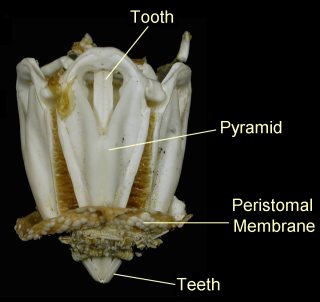
The oral surface of an urchin is on the bottom where its five teeth can be found (contained within "Aristotle's lantern", one of nature's most impressive feeding structures - more on this in a later post). The aboral surface is on top and contains the anus, surrounded by aptly-named anal plates, which are in turn surrounded by genital plates, each of which contains a gonadopore, through which gametes are released. One of the gonadal plates (known as the sieve plate) contains the madreporite - the structure through which water is drawn to power the water vascular system, the hydraulic system used by echinoderms for locomotion.

General Ecology
Sea urchins are epifaunal, using their Aristotle's lantern to graze upon algae and sessile organisms. Their spines are used for protection against predators (otters, fish, sea birds). Some urchin species have specialized spines that are capable of injecting venom that causes intense pain. Urchins can be voracious eaters and, if their numbers are unchecked, a population of urchins can completely strip an area of vegetation, resulting in a seriously-altered ecosystem generally termed an "urchin barren". Likewise if urchin numbers crash, the resulting algal growth can severely alter the local ecosystem.

Ok, it's quite late, so that's all for now. More on these lovely, non-evil creatures next week.
Cool. "Non-evil?" Not so sure. But cool.
ReplyDeleteHi - interesting and fascinating. Thanks. Have you any information on annual bands on the interambulacral plates of sea urchins? Can they be seen/counted on living urchins?
ReplyDeleteJane -
ReplyDeleteThe bands are not visible in live urchins - the plates/test is covered by a thin layer of epidermis tissue in living urchins. The only way to see the bands is with a cleaned test, free of all the overlaying spines and tissue. Thus, the urchin must be dead.
Also, I would be careful about calling the bands annual - they are probably more irregular than that - indicating periods of growth vs. periods of no growth.
thx, man, im doin a powerpoint presentation for my marine science class, and i chose sea urchins in general the post came in handy
ReplyDelete