Friday, February 09, 2007

Blood: It's What's For Dinner


The diversity of life really is amazing. Just about every possible niche you can think of has been exploited at some point - if there is a way to make a living out there, you can bet natural selection has shaped some creature to utilize it. Take sanguinivores for example - better known as "blood-suckers" (Latin: sanguinis = blood; vorare = to eat).

Blood is a protein-rich material so it is not so surprising that some creatures utilize it as a food-source. In fact, sanguinivory is not so uncommon - we all know about mosquitoes, ticks, biting flies (deer/horse flies) and have some exposure to those "mysterious" creatures of the dark - vampire bats (though I bet you'd love to know more). But did you know that there are also vampire birds? Yup, blood-sucking birds.

You know those sweet, helpful, caring birds that eat the awful, ugly ticks and bugs off the backs of rhinos and giraffes, thereby preventing diseases and alleviating discomfort? Well, it turns out that they might not be so sweet and innocent after all. And on our favorite playground of natural selection, the Galapagos Islands, one of 'Darwin's finches' is a blood-sucker - this one doesn't even pretend to be helpful.

I'll let you read the bloody details on your own. Below are some links to some info on sanguinivory, blood-sucking birds, and vampire bats (I've left out mosquitoes, ticks, and flies - they're just too icky). The posts actually follow an order and are from one of the new blogs I am enjoying (yes, I know I'm a geek) - Tetrapod Zoology. There's a lot of info in the following posts, so take them slow. Enjoy!

Check this video out first:

Video: Vampire finches


Then read these in order:

Evolution of vampires

Evolution of vampires, part II

Evolution of vampires, part III

Vampire finches

Vampire Bats

Monday, February 05, 2007

Just call me Heraclitus

As you all know, I have issues with "stasis". As such, I have made some (slight) changes to the blog. Obviously, the color scheme and layout has been changed. I have also added a "Category" tab to the posts so posts on similar topics can be easily accessed as a unit (e.g. Evolution, Marine Biology). Also, the host for the blog (blogger.com) has updated their services and now seem to require everyone to use a Google account to participate in the blog. So, If you would like to continue posting to this blog, you'll have to sign-up for a new gmail account - you should be prompted to do so when you try to log-in. I'll continue to post items as I find/think about them. Hopefully, all of you will continue to read and comment.

(don't know who Heraclitus is? Look him up!)

Friday, February 02, 2007

Sloths, revisited


If you recall, back at the beginning of last semester, I blogged about sloths after James' question about their body temp and enzymatic activity. Well, still no answers on their enzymes, but I was surfing around and came across this article on sloths - primarily about their evolutionary history. I figured you guys are getting into the diversity of life on Earth and the various eras/epochs of the Earth's history and thought that this article fit right in. Don't get bogged down by unfamiliar terms the author uses to refer to other groups of animals - even without knowing these terms, the general gist should be clear.

Who knew there were once aquatic sloths? Or possible predatory sloths? Or that they once lived in colder areas? Our extant (the opposite of 'extinct') sloths seem pretty boring by comparison. Where's that time machine?

Ten Things You Didn't Know About Sloths

Sunday, January 28, 2007

Thanks

Just wanted to thank you all for being a great class and for keeping me somewhat sane during my brief time at AHS. I truly am grateful to have met you all and to have been your teacher. I tried to make biology as exciting and interesting as I think it is and I wish you all good luck as you enter your last semester of high school. I know that this transition is less than ideal, but I also know that you, as a class, and Ms. Ravesi will move forward without missing a step - just keep working together and pushing forward like you've done all year so far. Each of you brings different talents to the classroom, which is one of the things that I enjoyed most - the combination of personalities that made the classroom comfortable, engaging, dynamic, interesting, and fun. I will miss you.

Even though I cannot be there for you in the classroom, I am going to try to keep posting interesting/useful items here on the blog. Also, feel free to email me if I can help you with anything - or post questions here.

Well, all for now. For those of you who see this, please relay my sentiments to the rest of the class. Thanks and good luck!

Monday, January 22, 2007

Tree of Life


The Tree of Life Web Project is an amazing database that is attempting to reconstruct the evolutionary history of life on Earth. Essentially, the Project is a database of cladograms. The amount of information there is enormous and the various terms that are used to describe the groups of organisms can be daunting, but it is a fun place to explore (well, I think it's fun anyways). Here are a few links to help you start your exploration (and fun)...

(tip: you can click on the triangle at the base of any cladogram or the "containing group" link to go back in evolutionary time)

Placental Mammals - most "traditional" mammals

Diapsida - not many cladograms here, but follow the links to see the unexpected bird relationships

Animals - from sponges to humans

Eukaryotes

The Tree of Life homepage

Monday, January 15, 2007

New Marine Life Form


Yet another example of how much more we have to discover about the natural world - an entirely new branch of the evolutionary tree has been discovered in the Artic Ocean. This is not just a new species, but a lineage of life that has never been seen before - the picobiliphytes.

Superficially these new organisms are very small algae, but their DNA suggest that they are as different from other algae as land plants are from animals. It's exact place on the tree of life and how this discovery may help us learn more about evolution (of eukaryotes in particular) are yet to be determined. Once again, we can see how the the study of biology is constantly pushing forward - just how thick will the AP textbook be 15 years from now?!?!

New Form of Life


(thanks to my wife for bringing this discovery to my attention!)

Tuesday, January 09, 2007

Human evolution


Given the fact that we are all Homo sapiens it is not surprising that there was an interest in class about the evolution of humans. There are so many interesting and thought-provoking questions that I thought I would direct you to some websites that discuss our origins:

The Evolution of Man - a site maintained by the BBC that contains a number of good articles

Becoming Human - an online documentary about human evolution

The Genographic Project - National Geographic's project on the geographic expansion of humans out of Africa

there are plenty more sites out there, but this should give you a good start...enjoy

Monday, January 08, 2007

Frogs in pots!!!WHAT?!!!!!1


Hello everyone. I thought since everyone enjoyed my geoducks post so darn much, that I would try my luck again. In this case it has to do with Frogs as you might have guessed. I'm not sure if it is the fact that frogs are naturally unintelligent, or it is a matter of adaption. People might remember what James was talking about in class today when he said that people that crashed in an airplane, didn't not get out of the plane when it was burning. They could have easily have gotten out, but choose not too. I have a feeling that this might be an example of what James was talking about.
So here is how the story goes. There is a story that I have heard a fair amount of times about frogs in pots. I have no idea who would test this theory out, but many apparently have. When a frog is put into a pot filled with Hot water, it will immediately hop right out. If the water is relatively cold the frog will react by staying in the pot. It does not mind the cold as much. This is understandable. The confusing part about the story is that when the frog is put in relatively cold water and the temperature goes up incrementally, the frog does no jump out. If someone was to turn the heat up two degrees at a time the frog has no reaction. Instead of hopping out when it gets to hot, it boils up inside and dies.
I figured it was an interesting idea, that might have something to do with what James was talking about in class today. I don't think the frog wants to die, but it is more of a mental issue within the frog's mind. It is either a question of pyschology or it is a matter of neurotransmitters and nerve impulses. If anyone has any information why this occurs, or any guesses just put them in the comments section.

Tuesday, January 02, 2007

Phospholipids of the Deep...


I know it's going to seem like I am fawning over the Deep Sea News blog (and I guess I am a bit), but this post was really too relevant to pass up...

Their newest "Thing to know about the deep sea" post basically discusses everything we covered in the first term of class - biochemistry, cell membranes, phospholipds, saturated and unsaturated fatty acids, transport across membranes, enzyme kinetcis, etc. - all with a deep sea twist. In fact, I bet you guys could figure out some of the details given what you learned back at the beginning of the semester.

In fact, before you click over to their post, think about the following details about the deep sea and how it might affect the biochemistry of cell membranes and enzymes (this is a good way to review the past material too!):

a) In the deep sea pressure on cell membranes may be as much as 1,000x more than on land.
b) The deep sea is very cold (as low as -1 degree C)

How do you think these two things would affect:
1) The fluidity of cell membranes
2) The function of enzymes

And how do you think deep sea critters have handled these effects? Post your ideas here in the comment section before moving on to check out the post.

Deep Sea Biochemistry (post your ideas here before clicking over - don't cheat!)

The Sound of Silence...

Here's the link to that article I mentioned in class about the not-so-silent mutation. New things everyday...is there anything more facinating than biology? (that's a rhetorical question by the way)

The Sound of a Silent Mutation


Saturday, December 30, 2006

Deep Sea Welcome

The link I included to the Deep Sea News blog a few posts ago has been noticed by the scientists who run it and have officially welcomed our class via a blog entry there. You should check it out and take advantage of the spirit of cooperation and interactivity that these blogs give us.

Here's their link again:

Deep Sea News
(scroll down a bit to find the 'Welcome Attleboro' post)

Friday, December 22, 2006

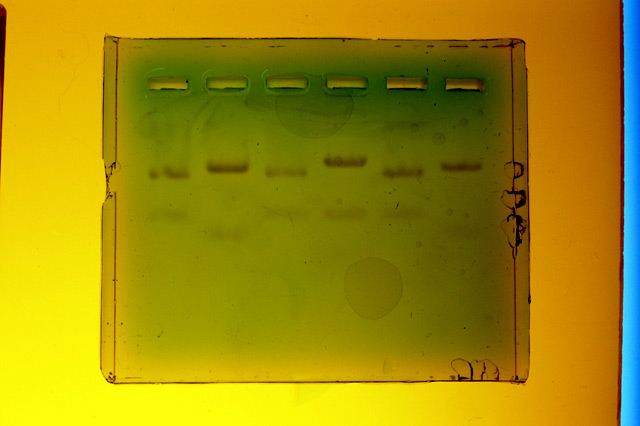
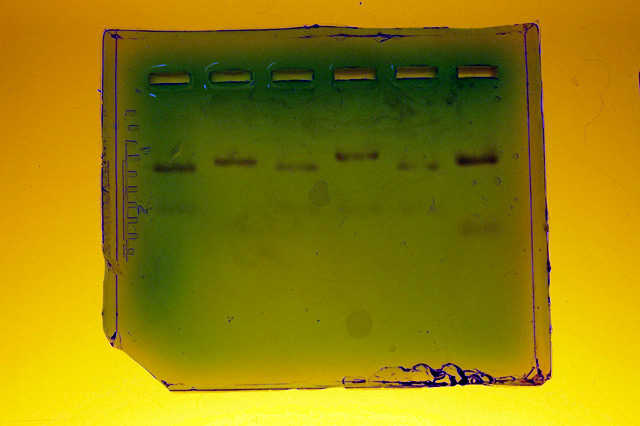
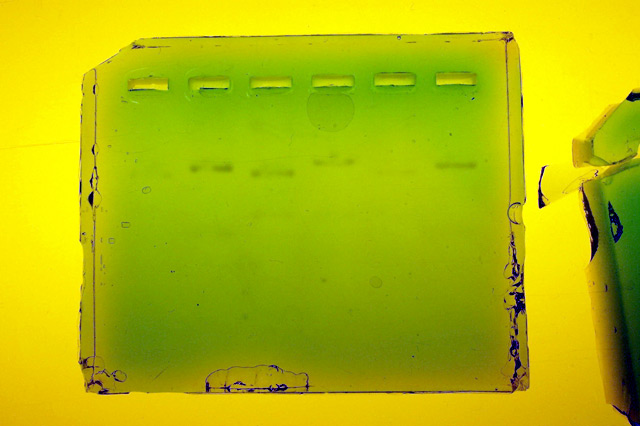
(most of) Your Gels

Not my best photographic work, but here you go. I tweaked them a bit in Photoshop to better bring out the set of second bands. Click on the photos for a larger image.


Where do plants come from?


We've been discussing in class a bit how we as a society are able to genetically engineer organisms - a technology that has taken hold over the past 30 years or so. But the natural world has been genetically engineering for millenia - not with anything technological or with that high a success rate, but effective nonetheless. We've mentioned earlier in the year how chloroplasts and mitochondria are believed to have evolved from prokaryotes that were engulfed by larger single-celled organisms - a process called endosymbiosis. Quite an amazing feat - esssentially harnessing the genetic power of one organism to help you survive. It was long believed that the evolution of algae and plants all stemmed from a single endosymbiotic event and that all chloroplasts share a common ancestor some 500 million years ago. But new research has shown that this may not be the case. By sequencing and comparing the genomes (full genetic makeup) of various chloroplasts (remember that chloroplasts and mitochondria have their own DNA) researchers have discovered that there were likely at least two independent endosymiotic events that lead to chloroplasts. This has many implications, including the idea that if this sort of thing can happen twice, why not more. And if it has happened more than once, what does this mean about the origin and evolution of the various photosynthetic organisms around today?


As a side note, this article/research is a good example of a branch of biology that studies the very early branches of the tree of life - basically delving back 100s of millions of years to examine how life emerged. Interesting, but difficult work.


Delving Into Chloroplasts' Past


Wednesday, December 20, 2006

Sea of Life: part II

For those of you interested in marine biology check out the following blog on the deep sea. I especially like the "25 things you need to know about the deep sea" series.

Deep Sea News

(actually, a lot of the blogs housed over at ScienceBlogs.com are pretty good)

Tuesday, December 19, 2006

Genetically Modified Organisms


Genetically modified plants and animals are becoming more and more common in our lives. Some are purely designed to help scientists more easily study some aspect of biology while others are important for their medicinal or food value. The image here is a picture of grains of golden rice - the rice strain that has been genetically engineered to produce beta-carotene presumably to make it more nutritious, though others argue that it is nothing more than a marketing scheme. There are a lot of concerns around Genetically Modified Organisms (GMOs) and like just about anything there are pros and cons that need to be considered when deciding whether we should proceed in a certain direction with GMOs. To help you learn more about GMOs and the science behind them here are a few links:

WikiPedia article on genetic engineering - a good general article


New Scientist - this section of this website is dedicated to all things concerning GMOs. Scroll down to see an list of about a billion news articles on GMOs (well, maybe only a million).

Monday, December 11, 2006

Sea of Life


Here's an interesting article that highlights some of the marine research that was done this past year. It's amazing how much we still have to learn about the natural world - just when people think we couldn't possibly discover anything more, up pops a shrimp thought extinct for 50 million year or schools of fish 20 million strong. Amazing stuff.

Census of seas reveals amazing forms of life


Friday, December 08, 2006

Solutions to Genetics Problems

Here are the answers to the handout of genetics problems.:

Answers


Tuesday, December 05, 2006

Virtual Fly Lab


For those interested in playing around in the virtual world of fruit fly genetics, here's the link:

Virtual Fly Lab


I'm also interested in hearing whether or not you found the site and the activities interesting and/or helpful.


UPDATE: want to order your own Drosophila? Check this out.


Monday, December 04, 2006

Is That a Fungus In Your Brain?


this video is really just too cool - a parasitic mushroom that takes control of an insect's brain.

video here

Friday, December 01, 2006

Inner Life of Cells - Part II


Here's the link to the extended version of The Inner Life of Cells. This is the full-length version that does not have the cool music, but does have a narration explaining everything. It is really rather dry - even I am am having a hard time watching the whole thing - but is it interesting to hear the various components explained.

Inner Life of Cells
(when you follow the link you'll need to wait a few seconds before the Harvard copyright warning gives way to the video)